ADHD Time Blindness at Work: Deadlines, Meetings and Accommodations
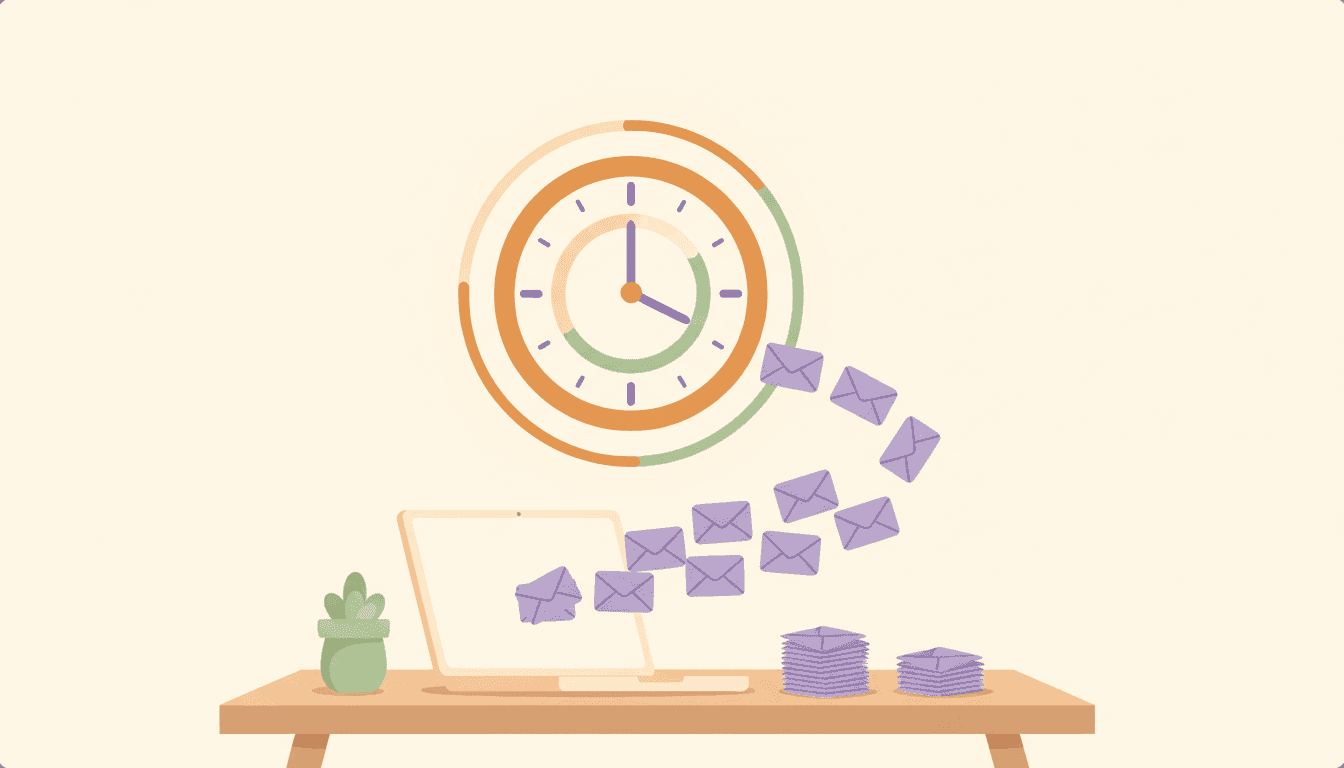
It is 1:40 and you open your inbox to clear a few quick replies before starting the report. The report is due Friday. You know this. You have known it for two weeks, and it has been sitting in your mind as something comfortably far away.
You look up and it is 4:15. Nothing on the report has moved. You answered eleven emails, rewrote one of them three times, and went down a shared-drive rabbit hole looking for a file nobody asked you for. Your 4:00 call started fifteen minutes ago. Friday, which felt like a distant country at lunchtime, is suddenly the day after tomorrow.
If your working life has a lot of afternoons like this, you are not lazy and you are not careless. You are running a demanding job on an internal clock that does not keep time reliably, in an environment that assumes everyone's does.
What Is ADHD Time Blindness at Work?
ADHD time blindness at work is difficulty sensing how much time has passed, how long tasks will take, and how close a deadline is, showing up in a job. It looks like missed deadlines, meetings that overrun, afternoons that vanish into email, and estimates that are wildly off, despite real effort and care.
Time blindness itself is a broad pattern that touches every part of life, and our guide to how time blindness works covers the full picture. Work is where it tends to cost the most, because the costs are visible to other people, they land on performance reviews, and they arrive with a heavy side order of shame.
Why Work Time Slips: What the Research Says
Psychologist Russell Barkley has long described ADHD as a difficulty using an internal sense of time and future consequences to guide what you do right now. One of his most practical ideas is the "point of performance": help works best when it sits at the place and moment where the behaviour needs to happen, not in a plan you made on Monday morning. A deadline written in a project tool is a long way from the point of performance. The 2:15 moment when you should be stopping email and opening the report is exactly at it.
The formal research on adult time perception is thinner than you might expect. A 2023 review by Christian Mette found that studies on time perception in adults with ADHD are scarce, but that adults with ADHD do show problems estimating time intervals, and often report time-management problems that affect work, job satisfaction and stress. The findings vary between studies, so it is fair to say the lab evidence is suggestive rather than settled. The everyday evidence, for most people reading this, is not in much doubt.
Modern office work then stacks the deck. Most knowledge jobs remove the external cues that used to mark time: there is no bell, no shift change, no colleague packing up at five. Remote work strips away even more. With no commute, no lunch crowd and no one walking past your desk, the only clock is the one in your head, and that is the one that runs unreliably.
This is also why the usual advice to "just plan better" falls flat. Plans live in the future. ADHD attention lives in the present, which means the most useful support is whatever reaches into the present moment and taps you on the shoulder.
Where It Shows Up at Work
- The deadline cliff. A two-week project feels like it has no urgency for twelve days, then becomes a crisis that eats your evenings for the last two.
- Meetings that run long, and back-to-back days with no gaps. You lose track inside a conversation, then arrive late and flustered to the next call, still carrying the last one. Meeting-to-meeting transitions take more out of an ADHD brain than a calendar ever shows.
- The afternoon that disappears into email. Inbox work is reactive, endless and mildly rewarding, which makes it a perfect place to lose two hours without noticing.
- Estimates that are not even close. You say "half a day" and mean it, and it takes three. Or you pad everything so heavily that you look slow.
- Losing whole days to the interesting task. Hyperfocus on the one fascinating problem can quietly swallow the deadline on the boring one.
- Remote days with no shape. Without the structure of an office, start times drift, lunch disappears, and the working day bleeds into the evening.
- Late, in a way that gets noticed. Time blindness at work often shows up as small, frequent lateness that colleagues read as disrespect, which is part of the ADHD tax paid in reputation rather than money.
How to Manage Time Blindness at Work
Turn every deadline into dated checkpoints.
A single due date gives your brain one moment of urgency, at the very end. Break each project into three to five checkpoints with their own dates: outline by Tuesday, first draft by Thursday, review on Monday. Put each one in your calendar as an event, not a task, so it appears in the day where you will actually see it. You are building small, close-up deadlines that your brain can feel, instead of one large one it cannot.
Put buffers around every meeting.
Set your default meeting length to 25 or 50 minutes, and treat the gap as part of the meeting rather than free time. Block ten minutes after important calls to write down actions while you still remember them. If you tend to run over, ask someone in the meeting to call time, or set a gentle alarm at the five-minutes-left point so the wrap-up starts before the hour does.
Block the calendar, and make the blocks audible.
Calendar blocking works best when each block says what you will do, not just that you are busy: "Draft section two" holds better than "Focus time". Give email its own two or three fixed windows a day, so it has a place to live instead of leaking into everything. The weak spot of any block is noticing when it has ended, because time blindness hides that moment too. A steady external cue helps here. TimeAware plays a gentle chime or speaks the time at an interval you choose, so the drift into a two-hour inbox session gets interrupted at the first quarter-hour instead of at 4:15.
Keep an estimate log for two weeks.
Every time you start a task, write down how long you think it will take. When you finish, write down how long it took. Do not judge it, just record it. After a fortnight, most people find a consistent multiplier, perhaps everything takes about twice as long as they think. That number is gold. Multiply your gut estimate by it before you give a date to anyone, and your estimates stop being a guess and start being data.
Use body doubling for the tasks you keep avoiding.
Some work tasks are easy to do and close to impossible to start: the expense report, the performance self-review, the reply to the email you have been dreading. Sitting near a colleague, joining a virtual co-working session, or keeping a silent video call open with a friend can make starting feel possible. Our guide to body doubling explains how to set it up so it holds.
Tell your manager what helps, in practical terms.
You can ask for working conditions without telling anyone your diagnosis. "I do my best work when deadlines are broken into checkpoints" or "A quick Monday check-in on priorities helps me plan the week" are ordinary requests that good managers grant all the time. If you do choose to talk about ADHD, lead with what works rather than what goes wrong. If you want help with the wording, our piece on explaining time blindness to the people around you is a good starting point.
Workplace Accommodations for Time Blindness
If informal changes are not enough, many countries have formal routes for workplace adjustments. The details, and what counts as a disability, vary a lot by country and sometimes by employer size, so treat this section as a starting point for your own research rather than legal advice.
In the United States, ADDA notes that ADHD can qualify as a disability under the ADA when it substantially limits a major life activity, though a diagnosis alone does not automatically meet that definition. The Job Accommodation Network's ADHD page, a free advisory service, lists ideas such as to-do lists, meetings to discuss expectations, help with prioritisation, uninterrupted work time and assistive technology like timers, apps and calendars. In the UK, Acas guidance on adjustments for neurodiversity gives examples such as regular check-ins, planners that visually highlight deadlines, extra reminders, and breaking work into smaller tasks, and states that a worker does not need a diagnosis to be considered disabled under the Equality Act 2010.
Accommodations that tend to suit time blindness in particular include:
- Written deadlines with interim checkpoints, agreed with your manager rather than self-imposed.
- A short, regular check-in on priorities, weekly or even daily.
- Protected focus blocks with no meetings, and permission to keep notifications off during them.
- Written follow-ups after meetings, so actions do not depend on memory.
- Permission to use timers, visual planners or audible cues at your desk or on calls.
- Flexibility on start times or remote days, where the role allows it.
ADDA's advice on what to ask for echoes the same idea: explain the specific difficulty clearly, and ask for concrete things such as timers, whiteboards or desk planners, and regular meetings with your supervisor to set clear deadlines. Whether and how much to disclose is your decision. Formal processes usually involve sharing some information with your employer, so if you are unsure, an employment adviser, union representative or a free service like JAN can talk you through your options.
What a Missed Deadline Says About You
Most adults with ADHD have a private file of work moments they would rather forget: the deadline that slid, the meeting they walked into twenty minutes late, the look on a manager's face. It is easy to read that file as proof that you are unreliable, or that you do not care as much as other people do.
But look at what the file actually contains. Almost every entry is the same thing: time passing without a signal you could feel. That is a problem of information, and information can be added from the outside. Checkpoints, buffers, blocks, logs, a person nearby and a chime on the quarter-hour are all ways of putting time somewhere you can see and hear it.
Needing the deadline broken into pieces you can see describes how your brain tracks time. It says nothing about how much you care about the work.
If years of compensating at work have left you running on empty, our guide to ADHD burnout is worth reading next. Many women also notice time blindness getting harder with hormonal changes in your 40s, which is worth knowing before you blame yourself for a change you did not cause. Either way, the aim is a working day that catches you before Friday does, rather than a version of you who never loses an afternoon.
Frequently asked questions
What is time blindness at work?
It is the ADHD-related difficulty sensing time passing, estimating how long tasks take, and feeling a deadline approach, as it shows up in a job. Common signs include missed deadlines, meetings that overrun, afternoons lost to email and estimates that are far off, even when you care about the work.
Why do I miss deadlines even when I care about my job?
With time blindness, a distant deadline often carries no felt urgency until it is very close, so effort arrives late rather than not at all. Breaking the deadline into dated checkpoints gives your brain several near deadlines it can feel, instead of one far one it cannot.
How can I stop meetings running over?
Set default meetings to 25 or 50 minutes, ask someone to call time, or set a gentle alert five minutes before the end so the wrap-up starts in time. Leave a short buffer after important meetings to write actions down before moving to the next thing.
Is time blindness a reasonable accommodation request?
You would usually ask for accommodations that address the effects, such as written deadlines with checkpoints, regular check-ins, protected focus time or permission to use timers. Whether ADHD is legally covered depends on where you live and your circumstances. The Job Accommodation Network in the US and Acas in the UK publish free guidance, and this article is not legal advice.
Do I have to tell my employer I have ADHD to get help?
Not for informal changes. Many useful requests, like a weekly priorities check-in or deadlines broken into stages, can be framed as how you work best. Formal accommodation processes usually involve sharing some information, so it is worth getting advice from an employment adviser, union rep or a service like JAN before you decide.
Why is time blindness worse when I work from home?
Remote work removes many of the external cues that mark time in an office, such as a commute, colleagues arriving and leaving, and a shared lunch break. Without them, more of the timekeeping falls to your internal clock. Adding external structure back in, through fixed start times, calendar blocks and audible time cues, often helps.
How do I get better at estimating how long work tasks take?
Keep a simple estimate log for two weeks: write your guess before each task and the real time afterwards. Most people find a fairly consistent gap. Multiplying your gut estimate by that personal factor before committing to a date tends to be far more accurate than trying to estimate better by feel.
This article is for education, not medical advice. For diagnosis or treatment, talk to a qualified clinician. How we research our articles