ADHD Body Doubling: Why You Can Suddenly Work When Someone Else Is There
The expenses claim has been open in a tab since the second week of August. You have looked at it perhaps forty times. You have felt bad about it roughly the same number of times, which is its own kind of full-time job.
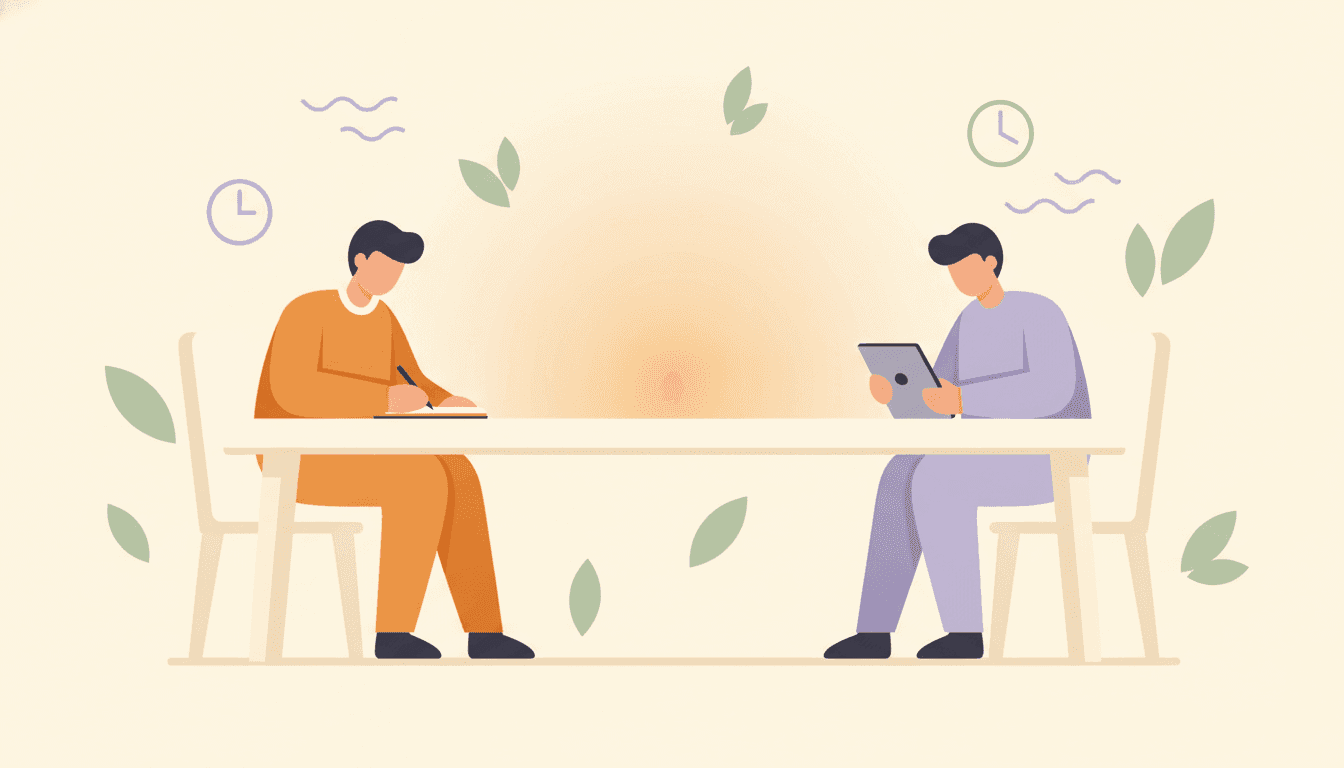
Then a friend comes over to do their own admin at your kitchen table, and you finish it in nine minutes. They did not help. They did not ask about it. They did not, as far as you could tell, look up once. And still: nine minutes, after three weeks.
This is body doubling, and if it has ever worked for you, the strangeness of it is probably part of what makes it hard to rely on. It feels like it should not count.
What Is ADHD Body Doubling?
Body doubling is the practice of doing a task in the presence of another person — physically or over video — while they do something entirely unrelated. The other person is not a helper, a supervisor, or an accountability partner in any active sense. Their only function is to be there. For many people with ADHD, that presence alone is enough to make a task possible that was not possible ten minutes earlier.
The term has been in use in ADHD coaching circles for decades and has spread widely through online ADHD communities, where virtual co-working sessions now do the same job for people who do not have someone to hand.
The Neuroscience: What We Actually Know
It is worth being straight about the evidence here, because a lot of writing on this topic overstates it. Body doubling is not a well-studied intervention. There is very little formal research testing whether it works, and almost all of the support for it is anecdotal — enormous quantities of anecdote, remarkably consistent across decades and communities, but anecdote nonetheless.
What we can do is line the phenomenon up against mechanisms that *are* well documented in ADHD, and several of them fit unusually well.
The first is task initiation. Russell Barkley's framing of ADHD as a disorder of executive function rather than attention puts the difficulty not in sustaining focus but in *starting* — in getting from intention to motion. Body doubling appears to act almost entirely on that moment. People rarely report that a body double helps them concentrate longer; they report that it helps them begin.
The second is the social reward system. Research reviews have noted that social interaction activates dopamine reward circuitry, and ADHD involves well-documented differences in dopamine signalling. A task that offers no intrinsic interest can borrow some from the social context it happens in.
The third is simply anchoring. A person in the room is a fixed external reference point, and ADHD brains do consistently better with external structure than internally generated structure — which is the same principle behind written lists, visible timers, and audible cues.
It is also worth noting what the mechanism is probably *not*. Body doubling does not appear to work through surveillance or accountability in any straightforward sense, because it works just as well when the other person cannot see your screen, is asleep on the sofa, or is a recording made months ago by a stranger. Any explanation that depends on being watched has to account for the fact that being watched is frequently not happening. Whatever is doing the work seems to sit closer to the presence of another person as an environmental fact than to their attention as a social pressure.
What It Tends to Look Like
- It works best on tasks you are avoiding, not tasks you find hard. Difficult intellectual work is often *worse* with someone there. Admin, tidying, email and forms are where it shines.
- The other person's activity does not need to match yours. They can be reading a novel while you do your tax return. Some people find a mismatch works better, because there is nothing to compare yourself against.
- Silence usually beats conversation. The moment it becomes social, it stops being body doubling and becomes an afternoon with a friend, which is lovely and gets nothing done.
- Video works, and so does a recording. Many people get the same effect from a live stream or a pre-recorded co-working video, which suggests the mechanism does not require genuine observation.
- The effect can fade with the same person. Novelty seems to be part of it, and a body double you use every day for a month often stops working.
- It reduces the emotional weight, not just the executive load. Tasks carrying shame — unopened post, overdue admin — are often the ones that shift most.
How to Make It Reliable
Ask for presence, not help.
The most common way this fails is that the other person, trying to be useful, starts helping. Then you are managing their involvement, explaining your system, and defending your choices, and the executive load has gone up rather than down. Be explicit and slightly blunt: "I do not need help, I need you to sit there and do your own thing." Most people are relieved to be given such an easy job.
Pick the right tasks for it.
Body doubling is a starting tool, so spend it on things that are hard to start rather than hard to do. Forms, filing, inbox triage, putting away laundry, phone calls you have been dreading. Save deep creative work for solitude — being watched, even benignly, tends to interfere with the kind of thinking that requires being lost in it.
Give the session a defined end.
"Let's work for a bit" is a container with no walls, and it usually dissolves into talking within twenty minutes. "Let's do fifty minutes and then have coffee" holds. This is the same principle that makes shaping a wait into blocks work: an ADHD brain navigates a period of time far better when it can perceive the far edge of it.
Use virtual doubling when nobody is available.
Video co-working sessions, ADHD community rooms, and even a silent video call with a friend who is also working all reproduce the effect for most people. The bar is lower than it feels — you do not need a close friend, a scheduled commitment, or a good reason.
Rotate your doubles.
If the effect fades with a particular person, that is expected rather than a sign it stopped working. Vary who you sit with, or vary the setting — a café, a library, a different room. Some of what you are borrowing is novelty, and novelty is renewable if you spend it carefully.
Build a version that does not need another person.
The uncomfortable limitation of body doubling is availability: the task is usually urgent at eleven at night when nobody is around. It is worth having a fallback that supplies the same external structure without a human being. A visible timer, a scheduled block, or a steady audible marker of time passing all provide a version of the anchor. This is the idea behind TimeAware — a gentle cue on the hour, so something outside your own head is keeping the shape of the day even when the kitchen table is empty.
Stop treating it as cheating.
This is the strategy people skip, and it costs them the most. A tool you feel embarrassed about is a tool you will not use in front of anyone, will not ask for, and will abandon the moment you are having a good week. Body doubling is not a crutch or a trick — it is external scaffolding, and external scaffolding is the correct response to an executive-function difference.
A Kinder Frame
There is a version of this where the lesson is that you cannot be trusted alone, and that version is both wrong and corrosive. What body doubling actually demonstrates is narrower and far more useful: the capability was always there. The expenses claim took nine minutes. It was never a nine-week task. What was missing was not skill, discipline, or care — it was a starting condition, and starting conditions can be arranged.
You did not need someone to make you capable. You needed something outside your head to make starting possible — and that is a requirement, not a character flaw.
Most of the shame around ADHD attaches to needing support that other people appear not to need. But the measure of a tool is whether it works, not whether you ought to have managed without it. If sitting near another human being turns three weeks into nine minutes, that is not a weakness you have discovered. It is a lever, and it is worth using on purpose.
If the tasks you cannot start are piling up somewhere specific, the doom pile problem is the natural next read.
Frequently asked questions
Is there real scientific evidence that body doubling works?
Not much, and it is worth being honest about that. There is very little formal research testing body doubling directly, and most support for it is anecdotal. What exists is a large and unusually consistent body of self-report, plus a plausible fit with mechanisms that are well documented in ADHD — task-initiation difficulty, dopamine differences in the social reward system, and better performance with external rather than internal structure. That is suggestive, not proof.
Does the other person need to be doing the same task?
No, and many people find it works better when they are not. A body double reading a book while you do paperwork removes any sense of comparison or competition. The mechanism appears to be presence rather than shared activity, which is why silent co-working videos work for a lot of people.
Why does body doubling stop working with the same person?
Novelty seems to be part of the effect, and it depletes. If your regular body double has stopped helping, rotating people or changing the setting usually restores it. This is expected rather than a sign the technique has failed for you.
Does virtual body doubling work as well as in person?
For most people, yes. Video co-working, community rooms, and even pre-recorded study-with-me videos reproduce the effect, which is itself informative — it suggests the mechanism does not depend on being genuinely observed. Try the lowest-effort version first before organising anything elaborate.
Is body doubling only useful for boring tasks?
It is most useful for tasks that are hard to start, which are often but not always the boring ones. It tends to work less well, or actively interfere, with deep creative or analytical work that requires being fully absorbed. Match the tool to the bottleneck: use it where starting is the problem.
What if I do not have anyone to ask?
Virtual sessions and public spaces both work, and the social bar is much lower than it feels — a library or a café supplies ambient presence with no arrangement at all. It is also worth building a non-human fallback, since the tasks that need doing rarely arrive at convenient hours. Visible timers and steady audible time cues supply some of the same external anchoring.
Is relying on body doubling a bad habit to build?
No more than using a calendar is. External scaffolding is the appropriate response to an executive-function difference, not a workaround for insufficient willpower. The practical risk is not dependence, it is availability — which is a good reason to have more than one form of scaffolding rather than a reason to use none.