Time Blindness in Relationships: How to Explain It Without Making Excuses
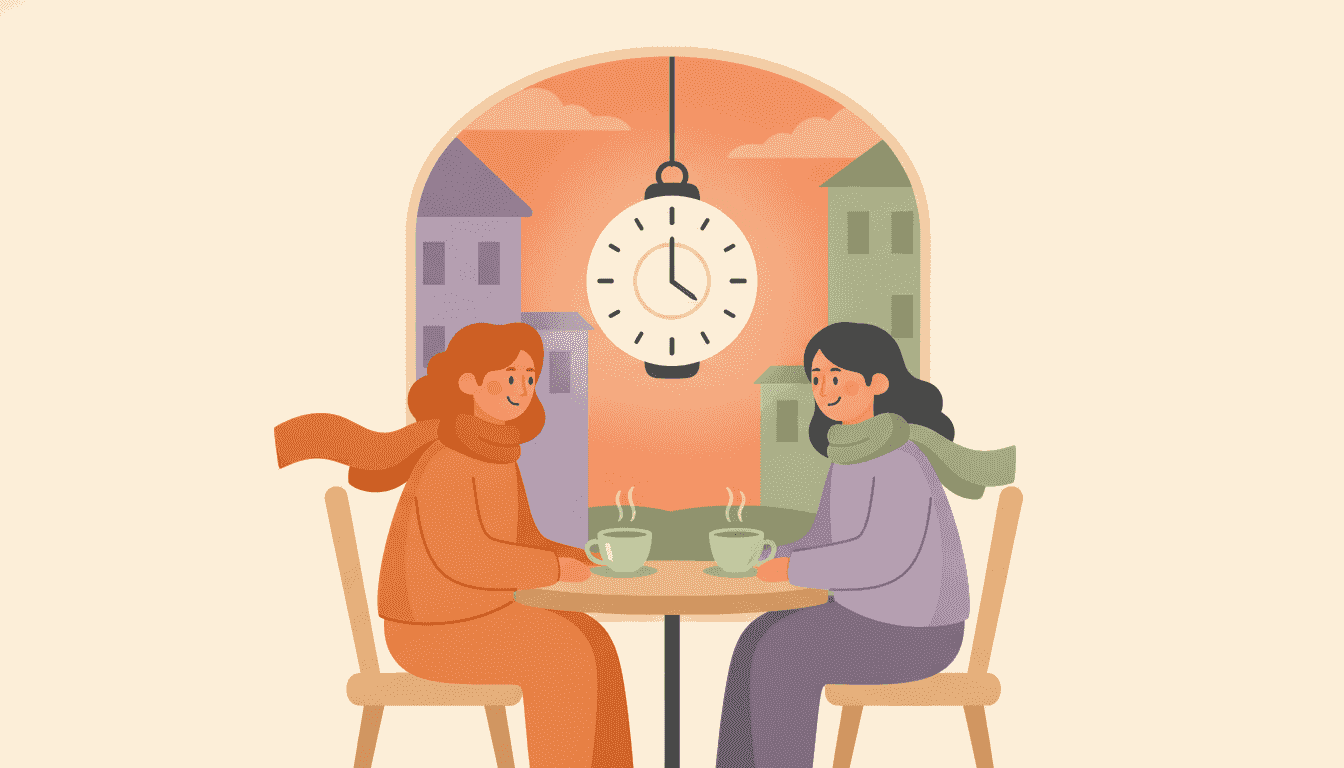
You told her seven. You meant seven. At twenty past six you sat down to answer one email, and when you looked up it was six fifty-eight and the restaurant was twenty-five minutes away. By the time you arrive she has finished a glass of wine and most of her patience, and the first thing she says is not hello. It is, quietly: "I just wish I mattered enough for you to be on time."
You do care. You cared the whole way there, rehearsing the apology. But caring about someone and noticing time passing run on different systems, and at twenty past six only one of them was switched on.
What Is Time Blindness in a Relationship?
Time blindness in a relationship is what happens when one person's difficulty sensing and predicting time, common in ADHD, gets read by the other person as a message about how much they matter. Lateness, forgotten plans and missed check-ins land as neglect, even when the person with ADHD cares deeply.
The time difficulty itself, and why hours disappear with ADHD, is covered in our main guide. This article is about what happens between two people: the meaning attached to the missing minutes, and the resentment that builds on both sides when nobody has words for it.
Real or an Excuse? What to Tell a Skeptical Partner
If your partner suspects "time blindness" is a convenient label, that is a fair question, and the most persuasive answer is an honest one. It is a popular term rather than a clinical one: ADDA notes that it isn't an official diagnosis, and you will not find it among the diagnostic criteria for ADHD. What the term describes, though, has been measured many times.
The short version you can share: a 2022 meta-analysis of 55 studies by Ivo Marx, Samuele Cortese and colleagues found that people with ADHD had more trouble telling very short durations apart than people without it, were more variable when estimating them, and were less accurate at producing a set interval. The difficulty is real, not something you invented to get out of trouble.
Two caveats make the explanation more credible, not less. Those lab tasks measure seconds, not the forty minutes that vanish into an email, and a 2023 review of adult studies by Christian Mette found mixed results. Saying so out loud shows your partner you are not overselling it. And "it is real" is only half of what a skeptical partner needs to hear. The other half is that an explanation is not an excuse: it tells you both where the fix has to go.
Psychologist Russell Barkley, who did much to popularise the idea, describes ADHD as difficulty letting a sense of the future guide what you do now. In a relationship, the future is usually a person waiting somewhere. When that future does not feel close, it does not pull on your behaviour until it is suddenly here, a split we explore in ADHD and "now vs not now".
How Time Blindness Shows Up Between Two People
- Lateness that reads as a ranking. Being twenty minutes late to dinner tells the person waiting that something else came first. Usually nothing did. You simply did not feel the time go.
- Plans that evaporate. You agreed to Saturday on Tuesday, and by Thursday it had slipped away along with everything else that was not in front of you. It is a close cousin of ADHD object permanence.
- "Five minutes" that means nothing. You say it sincerely and it becomes twenty-five. After a few years your partner stops believing any duration you give.
- Hyperfocus disappearances. You meant to call your friend back after one more thing, and the one more thing ran until midnight.
- Friendships that fade through silence. A message you meant to answer becomes a message it now feels too awkward to answer, and your friend reads months of quiet as a decision.
- One person becoming the clock. Your partner starts announcing departure times, counting down, checking whether you have started getting ready. Both of you hate it.
When One Partner Becomes the Household Clock
Melissa Orlov, author of The ADHD Effect on Marriage, has written about how this pattern usually starts. The partner without ADHD reminds, the reminder gets lost, and eventually it feels easier to take the task over. Each step makes sense, and together they produce a parent/child dynamic that leaves both people resentful. ADDA describes the same slide, with the non-ADHD spouse becoming a caregiver or parent figure who feels they have to nag constantly, as a route to burnout.
Time is often where this begins, because time is shared. Your partner starts calling out when you need to leave, then counting down, then telling you the party starts half an hour earlier than it does. It works, more or less, and it turns them into a supervisor nobody wants to be married to.
Resentment builds on both sides. They are tired of carrying the clock for two adults and of being cast as the nag. You are tired of being managed and of the running record of every time you got it wrong. If you live with rejection sensitivity, each reminder can land as proof that you are failing, and the reaction can become its own argument. When that pressure spills over, emotional dysregulation can turn a ten-minute delay into an evening-long fight.
Orlov's name for this is the symptom, response, response cycle. The lateness is the symptom. Your partner's frustration is the response. Your defensiveness or shutdown is the response to the response. Most of the hurt lives in the second and third steps, which is good news, because those are the steps both of you can change.
How to Explain Time Blindness to Your Partner
The explanation works best at a calm moment, not in the car on the way to the party you are late for, and when it comes packaged with responsibility. An explanation that ends with "so there is nothing I can do" will sound like an excuse, because it is one. An explanation that ends with "so here is what I am going to change" sounds like a partner.
Here is a short version you can adapt, send, or read aloud:
"I want to explain something about how my brain handles time, and I'm not saying it to get off the hook. When I'm absorbed in something, I don't feel time passing. Forty minutes can feel like ten. It's a well-studied part of ADHD, and it's why I can care about being on time and still be late."
"When I'm late, it says nothing about how much you matter to me. I know it still costs you something: the waiting, the worrying, feeling like an afterthought. That cost is real, and it's mine to fix."
"I don't want you to have to be my alarm clock. I'm going to set up my own reminders, and I'd like us to agree on which times are fixed and which can flex. If I'm running late, I'll tell you when I'm leaving, not just that I'm on my way."
Change the wording until it sounds like you. The order is what matters: what happens, what it does not mean, what it costs them, and what you will do about it.
Seven Ways to Share Time Without One of You Running It
Repair first, explain later.
When you arrive late, make the first sentence about them: "I'm sorry, you've been waiting and that isn't fair on you." Save the explanation for another day. In the moment, even a true explanation sounds like a defence, and it asks the person who was just kept waiting to do the comforting.
Sort plans into fixed and flexible.
Not every time matters equally. A flight, a school pickup or a wedding ceremony is fixed. A Saturday coffee or dinner at home can flex by fifteen minutes or so. Agreeing on the categories in advance tells you both where the buffer time matters most, and takes the moral weight off small slips.
Own your reminders, so your partner doesn't have to.
The fix for the household clock is not for the reminders to stop. It is for them to move out of your partner's mouth and into a system you set up and maintain: alarms for when to start getting ready, a shared calendar you both can see, and travel time written into the event itself. Your partner's job is to stop reminding. Yours is to make the reminders unnecessary. If your timing has recently got worse rather than staying the same, say so: for many women in their forties, perimenopause turns up the volume on time blindness, and a partner who knows that is less likely to read the change as caring less.
Put the time in the room.
Much of the friction comes from one person having to announce the time. An ambient cue does it for both of you: a clock in the room where you get ready, or a sound that marks the half hour or the hour without anyone saying a word. TimeAware does this with a gentle chime or a spoken time at an interval you choose, so "it's quarter past" comes from the phone instead of from the person who is tired of saying it.
Text when you leave, not when you arrive.
"Running late, be there soon" leaves your friend guessing. "Leaving now, about twenty-five minutes" gives them a real number and lets them decide whether to order. It also forces the useful question at the useful moment: am I actually leaving? If your lateness comes from a short estimate rather than a late start, our post on why you're always late walks through how to rebuild the number.
If you're the one waiting, name the impact and then step back.
If you are the partner without ADHD, you are allowed to be frustrated, and you do not have to pretend it is fine. Say what the lateness cost you ("I sat there for half an hour and felt foolish") rather than what it proves about them ("you only ever think about yourself"). Then hand the problem back. Orlov encourages couples to raise issues early and negotiate them together, because quietly absorbing the task is how the parent/child pattern starts. Stepping back might mean travelling separately to things that matter to you. That is a boundary, and it is kinder than becoming someone's schedule.
Tell your friends, and pick forgiving formats.
Friends see less of the effort than partners do. A single line helps: "I'm working on it, and if I'm late it is never about you." So do plans that absorb a delay, like meeting at a bookshop or a park instead of outside a film with a fixed start time. If the pattern is straining a marriage or a long friendship, a counsellor or coach who understands adult ADHD can help both people see the dynamic as the problem, instead of each other.
Lateness, Love and the Meaning You Give the Minutes
Over the years, what lateness costs adds up in money and missed moments, and also in the story you tell about yourself. Many adults with ADHD come to believe they are selfish, because that is the explanation they have heard most often.
The people who love you have been carrying a story too: that they rank somewhere below an email. Neither story is quite true, and both of you deserve a better one.
Being late is something your brain does. Repairing it is something you choose, and the choosing is where the love shows.
Explaining time blindness does not erase the impact, and it should not try to. What it can do is separate the symptom from the meaning, so the two of you can work on the problem together instead of on each other. Put the clock outside your head, give your partner their evenings back, and let "I'm sorry I'm late" be followed, more and more often, by something that changes.
Frequently asked questions
What if my partner thinks time blindness is just an excuse?
It is a fair worry, and arguing about whether time blindness is real rarely settles it. Share the short version: a 2022 meta-analysis of 55 studies found people with ADHD were less accurate at judging and producing time intervals, although those lab tasks measure seconds rather than hours and research in adults is mixed. Then show the difference in practice. An excuse ends with nothing changing. An explanation ends with a plan, such as your own reminders and an agreement about which times are fixed.
How do I explain time blindness to my partner?
Pick a calm moment rather than the middle of an argument about lateness. Explain what happens (you do not feel time passing while absorbed), what it does not mean (it is not a measure of how much they matter), acknowledge what it costs them, and finish with what you are going to change. Ending on a concrete commitment is what separates an explanation from an excuse.
Is it fair to expect a partner with ADHD to be on time?
Yes. Understanding why lateness happens does not mean accepting it without limits. What tends to work better than expecting effort alone is agreeing which times are fixed and which can flex, and expecting your partner to own a system of reminders rather than relying on you to be that system. Fairness runs both ways: you get reliability on the things that matter, and they get room on the things that do not.
How do I stop being the reminder person in my relationship?
Talk about it directly instead of quietly withdrawing, because a sudden stop can feel like punishment. Agree that your partner will set up their own alarms, calendar entries and travel buffers, and that you will stop announcing times. Expect a few rough patches during the handover. For events that matter to you, it is reasonable to travel separately so their timing does not decide yours.
Why am I on time for work but late for friends?
Work usually comes with external structure: fixed start times, other people expecting you, clear consequences. Social plans tend to have softer edges, so they rely more on your internal sense of time, which is the part that ADHD makes unreliable. It can feel as if friends matter less, but it is more often that work comes with outside scaffolding and friendships do not.
Can time blindness damage friendships as well as relationships?
It can, often more quietly. Friends see fewer of your efforts and more of the missed messages and late arrivals, and long silences can be read as a decision to drift apart. A short, honest explanation, a habit of replying with a holding message, and plans that tolerate a delay all help keep friendships from fading by accident.
Should we see a couples therapist about ADHD time problems?
If arguments about time have become a pattern you cannot break on your own, it is worth considering, ideally with a counsellor or coach who understands adult ADHD. Look for someone who works with both partners on the dynamic, rather than treating one person as the problem to be fixed.
This article is for education, not medical advice. For diagnosis or treatment, talk to a qualified clinician. How we research our articles