ADHD and Transitions: Why Stopping Is Harder Than Starting
You need to leave at half past. It is twenty-five past, and you are watching yourself not stand up. You are not doing anything important — you are reading something you will not remember by this evening. You are aware of the time. You are aware that standing up is the entire task.
And still there is a period, somewhere between thirty seconds and twenty minutes, in which you are simply unable to become a person who is standing up. Everyone talks about how hard it is for ADHD brains to start things. Far less is said about how hard it is to stop them.
Why Are Transitions So Hard With ADHD?
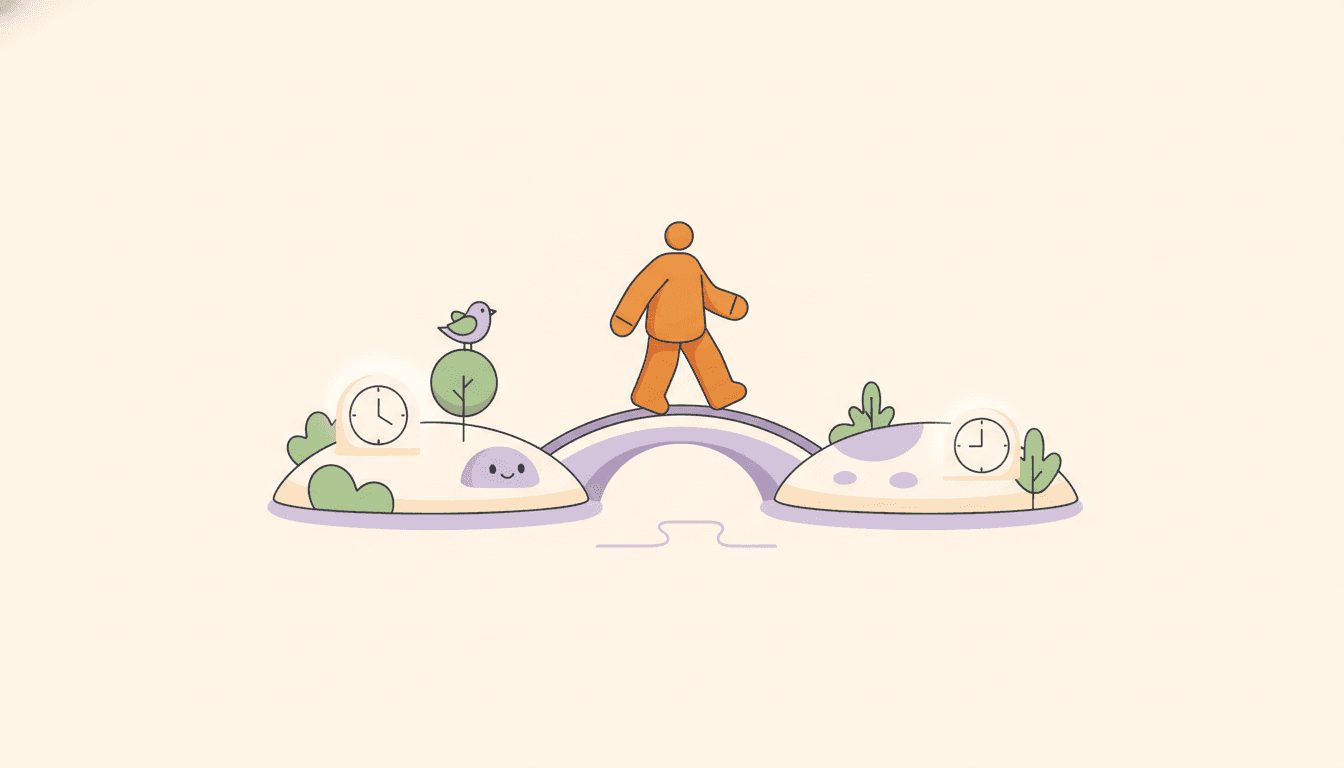
A transition is the shift from one activity to another, and in ADHD the difficulty sits in the shift itself rather than in either activity. Disengaging attention from what you are currently doing, holding the next task in mind, and initiating movement toward it are three separate executive operations that all have to happen in a short window — which is why the moment of changing can be harder than the task you are changing into.
This is why the gap between activities so often swallows more time than the activities do, and why "I just need to get up" can occupy fifteen genuine minutes.
The Neuroscience: Three Things Happening at Once
Russell Barkley's model of ADHD as an executive-function difference is useful here because it separates capacities that ordinarily feel like one thing. A transition demands at least three of them simultaneously.
The first is inhibition — stopping the current behaviour. This is the capacity most directly affected in ADHD, and it is doing the heaviest lifting at exactly the moment you need it.
The second is cognitive flexibility — releasing the mental set built around the current task and loading a different one. This is not instantaneous for anybody; there is a well-documented switching cost even in brains without ADHD. The ADHD difference is magnitude.
The third is working memory — holding the next task in mind clearly enough to move toward it while the current one is still occupying the workspace. For a brief window you have to hold both, and the workspace is small.
There is a fourth factor that applies particularly when the current activity is engaging. If you are in hyperfocus, the transition is not merely a switch — it is an extraction, and the pull of the absorbing task actively works against it. This is why interrupting good work feels almost physically difficult, and why the transition out of something enjoyable is usually the most expensive of all.
Worth noting too: the difficulty is largely indifferent to whether you want to do the next thing. People often assume transition trouble means avoidance, and then look for what they are secretly dreading. But the same stuckness shows up on the way to things you are genuinely looking forward to, which is the clearest evidence that the obstacle is mechanical rather than motivational. If it were reluctance, it would not happen on the way to the good things too.
Common Patterns You Might Recognize
- The last five minutes take twenty. You know you need to leave, you are aware throughout, and you leave late anyway.
- You dread short interruptions more than long ones. A meeting in forty minutes is worse than a meeting now, because the forty minutes are unusable.
- Coming home requires an unloading period. You cannot walk through the door and begin the evening. There is a stretch on the sofa first, and it is not optional.
- You over-run in the pleasant thing and under-run in the necessary one. Both are the same difficulty, pointed in opposite directions.
- You put off small tasks that require stopping something else. The two-minute job stays undone for weeks because it costs a transition, not two minutes.
- Days with several appointments feel disproportionately exhausting. Four meetings is not four units of work; it is four meetings plus eight transitions.
Why "Set a Reminder" Solves the Wrong Half
A reminder tells you the moment has arrived. That addresses knowing, and knowing is rarely what is missing — most people are entirely aware they need to leave. What the reminder does not supply is the executive work of disengaging, which begins *after* it fires.
This is why alarms set for the departure moment fail so reliably. At the instant it sounds you still have to stop, reorient, and move, and that process has a duration nobody has budgeted for. The alarm marks the start of the transition and gets treated as the end of it.
The fix is to give the transition its own time, rather than treating it as a boundary with no width.
How to Make Transitions Cheaper
Set the cue for beginning to stop, not for stopping.
This single adjustment fixes more lateness than any other. If you must leave at half past, the signal belongs at quarter past, and its meaning is not "go" but "begin the process of going". Most people set the alarm for the wrong moment and then conclude that alarms do not work for them.
Give every transition a named duration.
Stop treating the shift as instantaneous. If you have a meeting at two, the block from ten to two is not free — it is the transition, and it belongs in the calendar with a name. Once transitions are visible as real time rather than dead space, days stop being mysteriously overfull.
Use an external hourly signal rather than task-specific alarms.
Individual alarms have a failure mode: you set one for the important thing, ignore it while mid-task, and lose the rest of the day anyway. A steady ambient marker works differently — it keeps time continuously present rather than announcing single moments, so the hour arriving is something you notice rather than something that interrupts. This is what TimeAware does: a gentle cue on the hour, so transitions have a natural rhythm to hang on rather than requiring a separate decision every time.
Leave a deliberate handle on the current task.
Stopping is much cheaper if returning is cheap. Finish mid-sentence. Leave a note saying exactly what comes next. Keep the tab open. A great deal of transition resistance is unspoken fear of losing your place — of not being able to find your way back into the thing. Make the way back obvious and the leaving gets easier.
Build a physical ritual that carries you across.
A consistent small action attached to a transition eventually does the work automatically: standing up and filling a glass of water, closing the laptop lid, putting shoes on. The ritual matters less than its sameness. Novel actions cost executive function; repeated ones stop costing it, and a transition made of automatic movements is one you do not have to decide your way through.
Batch by mode, not by priority.
If four transitions cost more than four tasks, the answer is fewer transitions. Group similar work — all the calls together, all the writing together, all the errands in one trip — so you pay the switching cost once. Most productivity advice sorts by importance; sorting by mode is usually the better trade for an ADHD brain.
Budget for the landing, not just the departure.
Arriving somewhere is also a transition, and it is the one people forget. The twenty minutes after you get home, or the ten before you can start work after a commute, are real and predictable. Planning to walk in and immediately begin something guarantees a small daily failure. Plan for the unloading period and it stops being evidence of anything.
A Kinder Frame
What makes this difficulty so corrosive is how trivial it looks from outside. Nobody is impressed by "I could not stand up", including you. It reads as the smallest possible task, so failing at it seems to say something unusually damning — which is why so many people file it under laziness and stop examining it.
But standing up was never the task. The task was inhibiting a current behaviour, releasing a mental set, and loading a new one, using three capacities that ADHD affects most, in a window of about two seconds. Described accurately, it is not a small thing at all. It only looked small because the work was invisible.
You were not refusing to move. You were mid-way through a piece of cognitive work nobody counts as work, including you.
Transitions get cheaper when you stop pretending they are free — when they have a duration, a signal that starts early, a ritual to run on, and a rhythm marking the hours so the moment does not have to be manufactured from scratch each time. The gap between things is where an enormous amount of an ADHD day goes. It is also, usefully, one of the most fixable places to look.
Frequently asked questions
Why is stopping a task harder than starting one with ADHD?
Because stopping requires three executive operations at once: inhibiting the current behaviour, releasing the mental set you have built around it, and loading the next task into working memory. All three are areas ADHD affects, and they have to happen in a very short window. Starting a task generally requires fewer simultaneous operations, which is why the moment of leaving can be harder than the thing you are leaving for.
What is transition time and how much should I allow?
Transition time is the period spent shifting between activities rather than doing either one. Most people find ten to fifteen minutes is realistic for a significant switch, and longer when leaving something absorbing. Rather than using a rule of thumb, time your own transitions once — the real figure is usually considerably larger than expected, and having the actual number makes it much easier to plan around.
Why do I lose the whole hour before an appointment?
That is usually waiting mode, which is related but distinct. Transition difficulty is about the cost of the shift itself; waiting mode is about an upcoming commitment occupying working memory so that nothing else can start. They frequently compound, which is why a single appointment in the middle of the day can be so much more disruptive than its duration suggests.
Do alarms help with transitions?
Only if set for the right moment. An alarm at the time you need to leave marks the beginning of the transition, not the end, so it reliably produces lateness. Setting it for when you need to start stopping — typically ten to fifteen minutes earlier — fixes more lateness than any other single adjustment.
Why am I so tired after a day with several meetings?
Because you did not do four things, you did four things plus eight transitions, and each transition carries a genuine executive cost that nothing in your calendar accounts for. This is also why batching similar activities helps so much: it reduces the number of switches rather than the amount of work.
Why can I not start my evening as soon as I get home?
Arriving is a transition too, and it is the one most often overlooked. Moving from work mode to home mode requires the same disengaging and reloading as any other switch, usually while you are already depleted. The recovery period is predictable and real, and planning for it works considerably better than treating it as a nightly personal failure.
Does this get easier with practice?
The underlying switching cost does not seem to change much, but the total burden drops a great deal with structure. Consistent rituals become automatic and stop consuming executive function, batching reduces the number of switches, and external time cues remove the need to generate the moment yourself. Most improvement comes from redesigning the day rather than from getting better at transitioning.