ADHD Revenge Bedtime Procrastination: Why You Stay Up Even When You're Exhausted
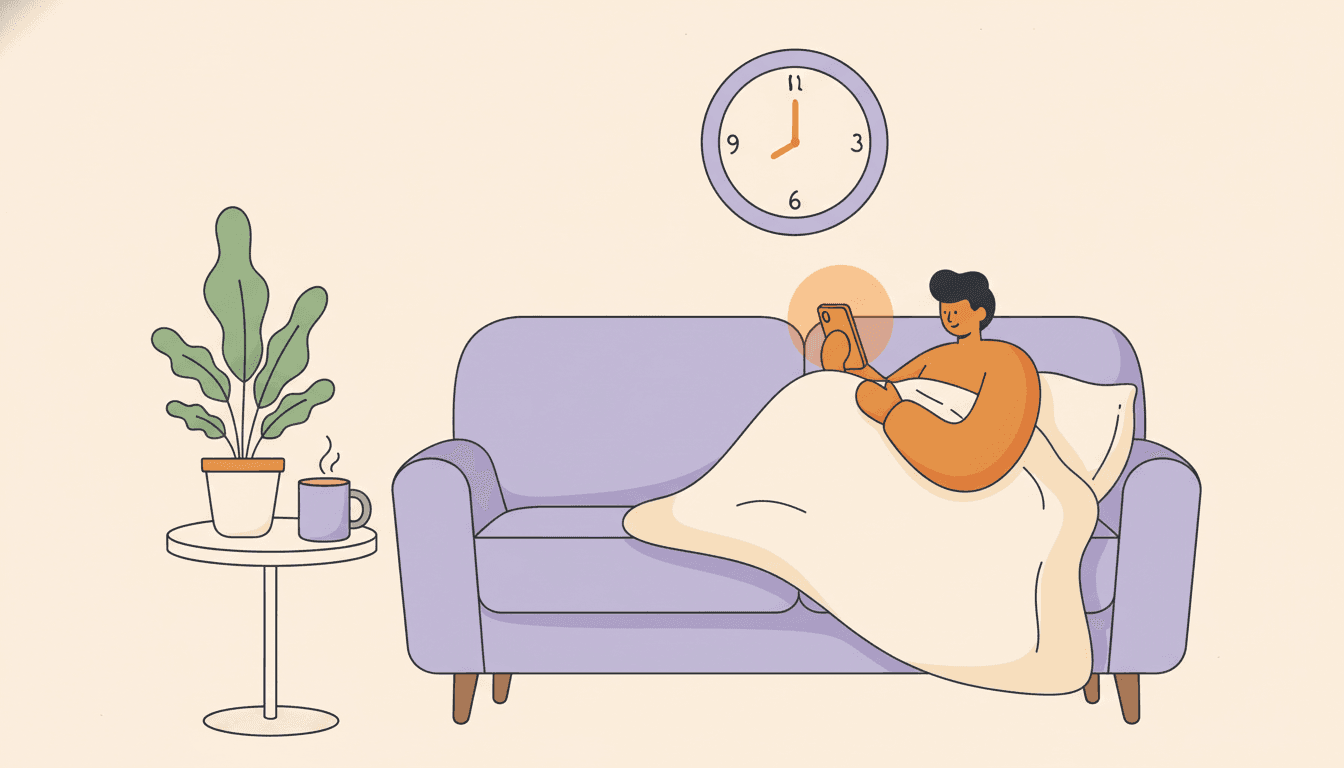
It is 11:47pm. You said you would be in bed by ten. You are on your fourth video — or third article, or seventeenth shopping tab, or one more episode that turned into two and a half — and there is a small panicky pull to claim something, anything, that belongs to you before tomorrow starts. You are not actually enjoying any of this. You are also completely unable to stop. The phone is heavy in your hand and your eyes are dry and you are going to do this again tomorrow.
What Is Revenge Bedtime Procrastination?
Revenge bedtime procrastination is the deliberate choice to delay sleep, sometimes by hours, to reclaim leisure time the day did not contain. You stay up past exhaustion not to enjoy yourself but to take back time. For ADHD adults it is a predictable pattern rooted in dopamine-seeking, transition difficulty and a brain that finally feels free at night.
The phrase comes from Chinese (báofù xìng áoyè, roughly "retaliatory staying up late") and spread into English to describe taking back hours from a life that did not give you any. The academic study of this behaviour traces back to Dutch psychologist Floor Kroese, who introduced "bedtime procrastination" in 2014 to describe people who go to bed later than they intended to without any external reason. The "revenge" framing is the felt experience the rest of us added: the small, defiant feeling of refusing to give the day everything you had.
The Neuroscience: Why ADHD Brains Are Drawn to the Night
ADHD brains run on a chronically lower baseline of dopamine and norepinephrine. All day they are scraping together enough of both to do tasks that mostly do not reward them in the moment. By the time the responsibilities have ended — kids in bed, inbox closed, partner asleep, household quiet — the brain finally has access to its own time and goes hunting for whatever feels good.
Night is the perfect hunting ground. Nothing is required of you. Nobody is asking anything. The phone is glowing with infinite, easy, never-ending dopamine. The same brain that could not bring itself to start a 20-minute task at 3pm will scroll for two and a half hours at midnight, because at midnight the scrolling has no opportunity cost it can actually feel.
There is also a circadian piece. Adults with ADHD have a documented tendency toward delayed sleep phase, meaning the internal clock runs later than the average. The "second wind" that hits at 10:30pm is not imagination; it is a real biological shift, and it collides with a culture that expects everyone to be asleep by 11. This is part of why the standard sleep advice ("just go to bed earlier") so rarely works for ADHD adults: the body is not actually tired when it is supposed to be, and the brain still has unspent dopamine appetite.
The final piece is transitions. ADHD makes it hard to move from one state to another. Going from "scrolling on the couch" to "in bed with the light off" is a state change, and state changes are expensive. The brain protests, the body finds reasons to stay, and another hour quietly evaporates.
Why It Can Hit Women Harder
Bedtime procrastination is not only a women's issue, but several studies have found women report somewhat more of it. A 2019 survey of Polish adults by Radoslawa Herzog-Krzywoszanska and Lukasz Krzywoszanski, for example, found the odds of severe bedtime procrastination were more than twice as high for women as for men. One plausible contributor has nothing to do with discipline: invisible labour. Many adult days, particularly women's, end with a long list of caretaking obligations that do not clock off at 5pm — childcare, household management, emotional support, planning tomorrow, anticipating other people's needs. By the time the house is quiet, the only window of the day that truly belongs to her is the one between when everyone else is asleep and when she finally collapses.
That window is small, hard-won, and feels precious in a way the rest of the day does not. Of course she does not want to spend it sleeping. The "revenge" is aimed at a day that had no room in it for her, not at any one person.
For ADHD women specifically the stakes compound. The next day's executive function is already running thin; sleep debt eats further into it; the cycle gets worse week by week, and if it runs unchecked for long enough it tips into full ADHD burnout — the collapse phase of exactly this loop. The hours stolen back at midnight cost double tomorrow. But that is a future-tense cost, and an ADHD brain has trouble keeping future-tense costs on the whiteboard.
Common Signs You Might Recognize
- The "one more" loop. One more video. One more article. One more episode. Each "one more" feels harmless on its own; together they form the entire late night.
- The 10pm second wind. You were dragging at 8pm. By 10pm you feel weirdly alert, almost wired, and it feels wrong to waste it on sleep.
- The phantom me-time. Most of the late-night activity is not actually fun: scrolling, refreshing, opening apps you have already opened. You are claiming the hours, not enjoying them.
- The transition refusal. You are in pyjamas, on the couch, knowing you should brush your teeth. Standing up costs more than the next 20 minutes of scrolling, so you don't.
- The morning regret. You wake exhausted, swear tonight will be different, and by 11pm you are doing exactly the same thing.
- The weekend that doesn't help. You sleep in, feel almost normal, and then the cycle restarts on Monday because the underlying time-poverty did not change.
How to Reclaim Your Bedtime (Without Hating Yourself)
The trick is not to grind harder against a brain that has very good reasons for doing what it is doing. The trick is to remove the conditions that make midnight feel like the only option.
Define the start of the wind-down, not the end.
Most people set a bedtime and miss it. ADHD brains do much better with a start time (the hour at which the transition begins) than with the bedtime itself. If you want to be in bed by 11, do not set an "11pm" alarm; set a "10:15pm: start winding down" cue. By the time you would normally have noticed the hour, you are already in motion.
Steal back me-time earlier in the day.
The single biggest lever is to make the day contain leisure that actually belongs to you, so that midnight does not have to. Even 15 protected minutes — coffee alone, a walk, a few pages of a book — make the "revenge" pull at night noticeably quieter, because you are not collecting on a debt the day refused to pay. This is not a hack; it is the actual cause of the problem.
Make the screen the boring option.
The dopamine isn't really coming from you; it is coming from what is in your hand. Turning the phone to grayscale, deleting the worst app from the home screen, charging it across the room: these are small environmental nudges that change the cost of the late-night reach. The hand will still reach; what it touches is what matters.
Anchor your evening to an external clock.
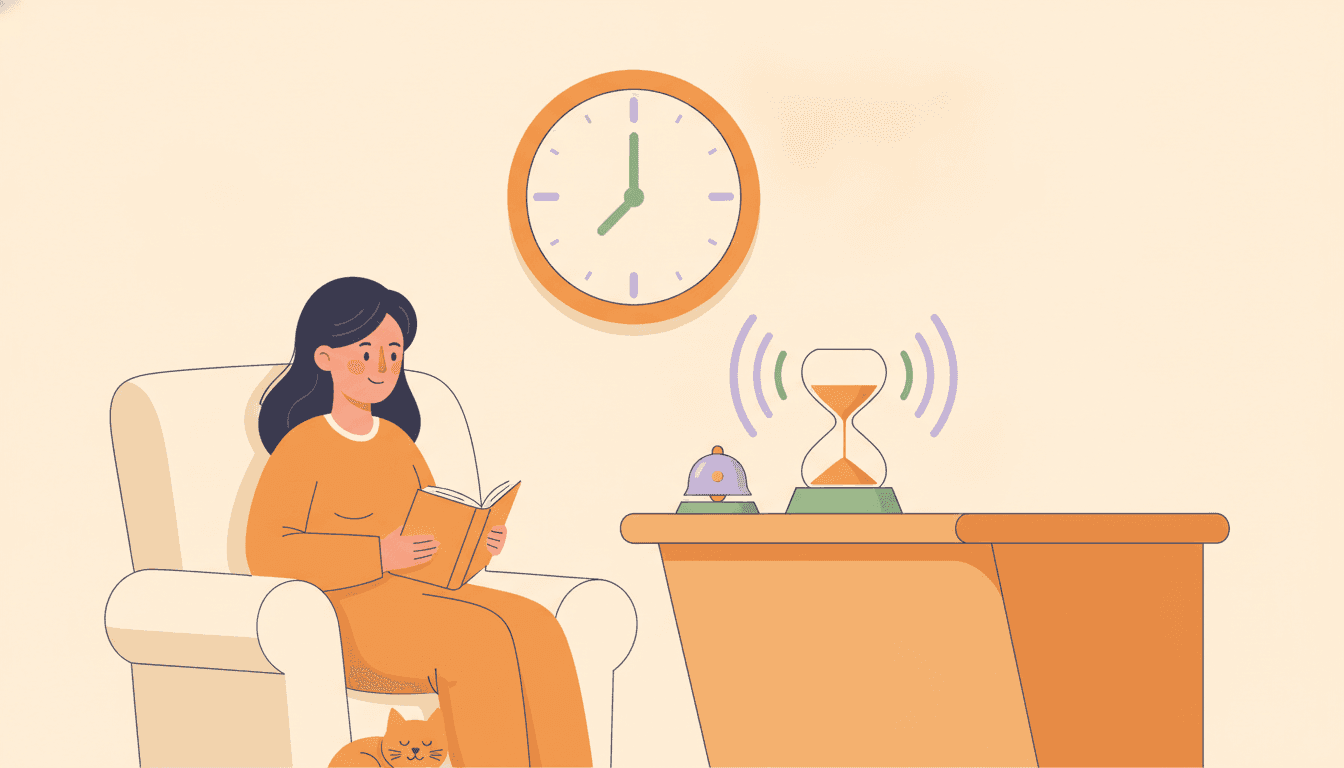
The biggest reason 10pm becomes 12:30am is that no part of your environment was saying so. A steady hourly cue — a calm voice or a gentle chime that announces the hour, on the hour, every hour — gives the evening a felt shape it otherwise does not have. This is the principle behind TimeAware: when 11pm is something you actually hear, the choice to keep scrolling becomes a choice instead of a drift. Without an external anchor, the difference between 10:15 and midnight is invisible from inside the loop.
Build a transition ritual the brain can predict.
The hardest part of going to bed is the state change. A short, predictable sequence — same three things, same order, every night — gives the brain a low-effort path through that change. Wash face, glass of water, lights down. Five minutes, no decisions required. The point is not the activities themselves; it is the absence of a decision at the moment your willpower is lowest.
Be kind to the past few weeks of yourself.
Self-blame is a stimulant. Lying in bed at 1am hating yourself for being awake at 1am keeps you awake until 2. The most useful thing you can do in that moment is accept that tonight is what it is, and that the system you are about to build is for next week. Shame does not earn you any sleep back, and it taxes the next day twice.
The Evening You Are Really Trying to Reclaim
Revenge bedtime procrastination is not weakness and it is not a failure of character. It is a brain pattern in a body that did not get enough of its own day. The fix is not to push harder on the bedtime itself; it is to give the day more room, and the evening more structure, so the late hours stop being the only place where you exist as a person.
You are not staying up because you are bad at sleeping. You are staying up because the day did not have you in it.
If the late-night scroll usually starts as "just a few minutes" and quietly turns into hours, our piece on hyperfocus explains the mechanism that takes the wheel. And if the underlying problem is that you really cannot feel time passing in the evening, time blindness covers why, and what to do about it.
Frequently asked questions
Is revenge bedtime procrastination an actual diagnosis?
No. The academic version, "bedtime procrastination," is a well-studied behavioural pattern first described by Dutch psychologist Floor Kroese in 2014. The "revenge" framing came later, originally from a Chinese phrase, and captures the felt experience of stealing time back from a day that did not contain enough of it. It is real and well-described, but not a DSM diagnosis.
How is this different from delayed sleep phase syndrome?
Delayed sleep phase syndrome is a clinical condition in which your internal circadian clock runs late — falling asleep before 1 or 2am is nearly impossible no matter what you do. Revenge bedtime procrastination is a behaviour: you could fall asleep, but you choose not to. The two often coexist in ADHD adults, which is part of why standard sleep advice fails. If you suspect DSPS, talk to a sleep specialist; treatment is different from the strategies in this piece.
I have ADHD — is this happening because of dopamine, or because of habit?
Probably both, and the line is fuzzy. The dopamine-seeking is the engine; the habit is the rails it runs on. Most ADHD adults find that addressing the underlying time-poverty (strategy 2) and the transition pain (strategy 5) does more than trying to break the habit head-on, because the habit is a coping mechanism, not the root cause.
Will going to bed earlier eventually reset me?
Sometimes, but not reliably on its own. A few nights of earlier sleep can reset your tiredness baseline, which makes it physically easier to go to bed at a reasonable hour. But if the underlying drivers — no daytime me-time, no evening transition, a phone within reach — are still there, you will drift back within a week. Lasting change is environmental, not motivational.
Is it really worse for women?
Several studies have found that women report somewhat more bedtime procrastination than men, though the gap is modest and not every study finds it. One plausible reason is invisible labour: many adult days end with a long tail of caretaking and household-management work that, on average, falls more heavily on women. The bedtime window often becomes the only protected hour, and the cost of giving it up to sleep is felt more sharply.
Does medication help?
Stimulant medication can either help or hurt your sleep depending on dose and timing — too late in the day and it actively keeps you up; too early and you crash and revenge-scroll harder in the evening. If you suspect your medication is part of the problem, this is a conversation to have with your prescriber, not something to self-adjust. Non-stimulant options exist for people whose ADHD and sleep are at war.
What if I am exhausted but still cannot put the phone down?
This is the dopamine engine running on fumes — your brain is so tired it has lost the ability to switch states, and the phone is doing the regulating for it. The most reliable intervention is to remove the phone from arm's reach before this moment hits, not to try to outwill it once you are in it. Future-you sets the trap; present-you just walks past it.
This article is for education, not medical advice. For diagnosis or treatment, talk to a qualified clinician. How we research our articles