ADHD Doom Piles: Why the Chair Is Covered and the Drawer Is Full
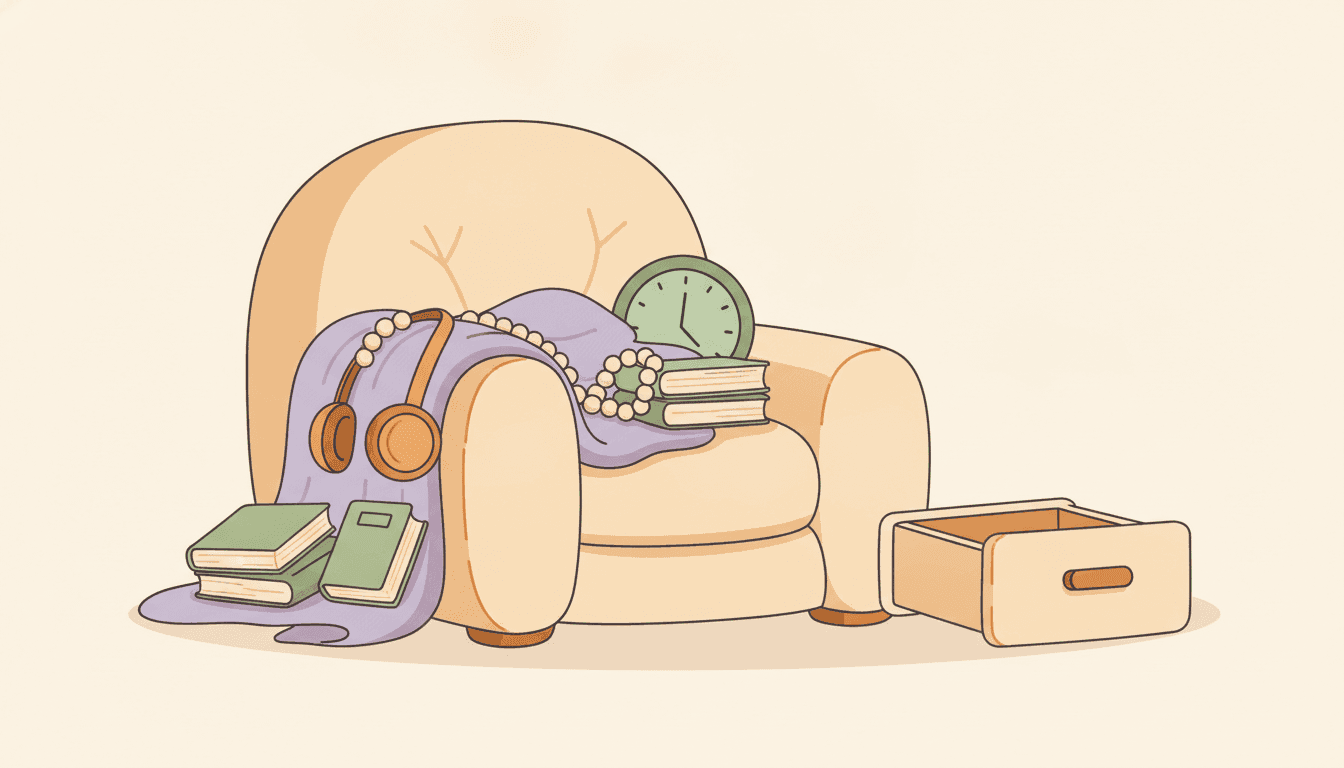
There is a chair in your bedroom. It has not been a chair for some months now. There is also a drawer, or possibly a box, or in the more ambitious households an entire spare room, containing objects that have no relationship to one another beyond having once been in your hand when you did not know where to put them.
You have tidied it before. You tidied it thoroughly, in a burst of energy, and it looked wonderful for about nine days. Then it came back, in exactly the same spot, at exactly the same rate — which is the detail that should tell you this is a system doing what it was built to do, rather than a personal failing repeating itself.
What Are ADHD Doom Piles and Doom Boxes?
A doom pile is an accumulation of unrelated objects in a visible place, formed because each item was set down rather than put away. A doom box is the enclosed version — a drawer, a tote, a carrier bag — usually created during a fast tidy-up when things had to disappear quickly. In ADHD communities "DOOM" is often expanded as *Didn't Organise, Only Moved*, which is a fair description of the mechanism.
The defining feature is not untidiness. It is that the pile has no organising principle, so there is no obvious point of entry — and its contents are individually decision-heavy, which is precisely why they were never put away in the first place.
The Neuroscience: The Pile Is Doing a Job
Here is the part that reframes it. Leaving things out is not the absence of a system. For a great many people with ADHD it *is* the system, and it is a rational one.
Russell Barkley's model of ADHD centres on working memory — the mental workspace that holds intentions alive while you do something else. That workspace is smaller in ADHD brains, and one of its casualties is the ability to keep track of things you cannot see. If putting the passport in the drawer means the passport ceases to exist in any practical sense, then leaving the passport on the side is not carelessness. It is a reasonable adaptation to a brain that does not reliably retrieve what is out of view. We have written elsewhere about how that disappearing act works.
So the pile begins as an externalised memory. Every item on it is a note to self.
The second mechanism is decision load. A doom pile is not one task; it is forty small unrelated decisions stacked in a heap. Where does this go? Do I still need this? Is this rubbish or is it important? Each requires a separate judgement, and each carries a small risk of being wrong. Executive function is the resource that makes those judgements, it is in short supply, and forty of them in a row is far beyond what a single sitting can fund.
This is why the pile is uniquely resistant. Washing up is one decision repeated. A doom pile is forty different ones, and it is the variety, not the quantity, that makes it impossible.
Common Patterns You Might Recognize
- The pile forms in exactly the same place every time. Usually a threshold — a chair by the door, the end of a counter, the bottom stair. These are the points where you arrive holding things.
- Everything in it is a deferred decision, not a deferred action. It is not a pile of things to do. It is a pile of things you could not classify.
- You know roughly what is in it. Which is the giveaway that it is functioning as memory rather than as abandonment.
- Fast tidying converts piles into boxes. Guests are coming, so the pile goes into a bag, and the bag goes in the spare room, and the bag is now permanent.
- You have a box of boxes. The doom box that was itself tidied into another container, at which point the contents are archaeologically inaccessible.
- It regrows at a predictable rate. Because clearing it changed the contents but not the conditions that produced it.
Why Ordinary Tidying Advice Does Not Work
Standard organising advice assumes the difficulty is knowing where things should go, and offers systems, labels, and matching containers. But most people with a doom pile can tell you exactly where every item belongs. Knowledge was never the constraint.
The constraint is that putting a thing away costs a decision plus a journey plus the risk of forgetting it exists, and doing that forty times consecutively costs more executive function than a person has on a Tuesday evening. Elaborate systems tend to make this worse, because a system with fourteen labelled categories asks *more* of the classification step, not less. The systems that survive in ADHD households are almost always cruder than the ones the internet recommends.
How to Actually Clear It
Sort by destination, not by category.
Do not ask what each item *is*. Ask which room it lives in. Four piles: bedroom, kitchen, bin, elsewhere. Destination sorting collapses forty distinct judgements into one repeated judgement, which is the whole game. Categories are for libraries; you need rooms.
Work in timed blocks, and stop when the timer stops.
Fifteen minutes, then stop even if you are mid-flow — especially if you are mid-flow. The classic pattern is a four-hour blitz that empties the room, exhausts you for three days, and teaches your brain that clearing the pile is a catastrophe to be avoided. Short repeatable sessions beat heroic ones, because the pile is a rate problem and rates are beaten by regularity.
Make the container obvious and singular.
One box by the door for everything that has no home yet. Not five labelled boxes — one. A single visible container is the smallest possible version of the pile's function, and it keeps the sprawl bounded without asking you to classify anything at the moment of arrival, which is the moment you have least capacity.
Give the pile a recurring appointment.
Anything that regrows needs maintenance rather than a cure, and maintenance needs a trigger you do not have to remember. Attach it to a fixed point — Sunday evening, or a specific hour — so the pile gets fifteen minutes on a schedule rather than waiting for a burst of motivation that arrives quarterly. An audible hourly cue helps here more than people expect; this is the sort of small recurring task that only ever happens if something outside your head announces the moment. It is what TimeAware is for.
Lower the bar for "away".
Away does not have to mean folded, sorted, and alphabetised. Away can mean in the right room. A jumper on the correct shelf in the wrong orientation is a success, and treating it as one is what makes the system survivable. Most ADHD organising failures come from a standard set too high to sustain, not from a standard set too low.
Handle the box before you handle the pile.
Boxes are worse than piles, because their contents have gone invisible and the emotional weight has compounded in the dark. Start with the most recent one, keep the bin bag open, and give yourself permission to discard anything you cannot identify. If it has been in a bag for eleven months and you did not miss it, that is information.
Fix the threshold, not the pile.
The pile forms where you arrive holding things. So put the solution there: a hook for keys, a shelf for post, a bin within reach of the door. Changing what happens at the moment of arrival prevents more accumulation than any amount of clearing does afterwards.
A Kinder Frame
It is worth noticing how much moral weight gets attached to this particular difficulty. Very few executive-function struggles are as visible as a covered chair, and visibility invites judgement — from guests, from family, and most punishingly from yourself, every single time you walk past it.
But the pile is not a statement about your character. It is a physical record of a brain doing something sensible: keeping things where it can see them, because it has learned the hard way that invisible means gone.
The chair is not evidence that you gave up. It is evidence that you found a way to remember, and then ran out of room.
That is a solvable problem, and it is solvable at the threshold rather than at the pile. Give the things a home you can see, give the clearing a recurring moment it does not depend on motivation to reach, and lower the standard for what finished means. The chair can be a chair again. It does not have to stay that way permanently to count.
Frequently asked questions
What does DOOM stand for in doom pile?
In ADHD communities it is usually expanded as "Didn't Organise, Only Moved", which describes how these piles form: things get relocated rather than put away, often during a fast tidy-up. The term is community shorthand rather than a clinical one, but it is a precise description of the mechanism.
Why do I always make the pile in the same spot?
Because piles form at thresholds — the places where you arrive holding things and have to make a decision while your hands are full and your attention is elsewhere. The chair by the door, the end of the kitchen counter, the bottom of the stairs. This is also why fixing the threshold with a hook, shelf or bin prevents more accumulation than clearing the pile ever does.
Is a doom pile the same as hoarding?
No. Doom piles are about deferred decisions and difficulty with task initiation, not about distress at discarding possessions. People with doom piles generally have no attachment to the items and are usually happy to bin most of them once they get started. Hoarding disorder is a distinct clinical condition with different features, and if discarding things causes you real distress, that is worth raising with a clinician.
Why does the pile come back after I clear it?
Because clearing changes the contents but not the conditions. The pile is produced by an ongoing process — arriving with objects, lacking capacity for the decision, needing things visible to remember them. Unless something at the threshold changes, the same process produces the same pile at the same rate.
Why can I clean for a friend but not for myself?
Someone else's belongings carry no decision weight for you. You are not deciding whether to keep them, whether you failed by not dealing with them sooner, or what they say about you. Strip the emotional and classification load out and it becomes simple physical work — which is also why body doubling and swapping tasks with a friend can be surprisingly effective.
What should I do with a doom box I cannot face opening?
Start with the most recent one rather than the oldest, keep a bin bag open beside you, work for fifteen minutes only, and allow yourself to discard anything you cannot identify. If something has been sealed away for the better part of a year and you have not needed it, that is genuinely useful information rather than a failure.
Do organising systems help with ADHD?
Simple ones do; elaborate ones usually make things worse. A system with many labelled categories increases the classification effort at exactly the moment you have least capacity for it. The systems that survive in ADHD households tend to be cruder than the ones usually recommended — fewer containers, broader categories, and a much lower bar for what counts as put away.