ADHD Fidgeting: When Movement Helps Your Brain (and When It's Eating Your Day)
You meant to send one email. Forty minutes later you are still holding your phone, the email is unsent, and you cannot quite say what you have been doing: scrolling, opening apps, closing apps, picking at your nail, refreshing the same feed twice. If this loop is familiar, you are not lazy or distracted. You are fidgeting. The same impulse that keeps your brain on for boring tasks can quietly turn into the most expensive habit in your day.
What Is ADHD Fidgeting?
ADHD fidgeting is small, involuntary movement, such as bouncing a leg, clicking a pen, twirling hair or scrolling a phone, that the brain uses to stay alert during demanding or low-stimulation moments. In ADHD it often works as self-regulation rather than distraction, and it only becomes a problem when the fidget absorbs the attention it was meant to support.
For decades fidgeting was treated as a symptom to suppress. Newer research describes it as compensatory: the brain's way of recruiting movement to reach the level of alertness it needs to focus. The same hands that cannot stop tapping during a Zoom call may be the reason you stayed in the call at all.
The Neuroscience: Why Movement Helps ADHD Focus
Attention regulation in the brain runs on dopamine and norepinephrine. ADHD involves differences in how both are signalled. Physical movement, even when it is subtle and repetitive, is thought to nudge alertness upward, which may be why rhythmic foot-tapping or hand-fidgeting seems to help many people with ADHD perform better.
The clearest evidence comes from studies that measured movement while people worked. In a 2015 study of boys aged 8 to 12, psychologists Dustin Sarver, Mark Rapport and colleagues found that children with ADHD did better on working-memory tasks when they were moving more, while typically developing children did slightly worse. A team including Julie Schweitzer then put ankle sensors on 10- to 17-year-olds and found that more intense movement went with better performance on a cognitive-control task in the ADHD group only.
Adults seem to show a similar pattern. In a 2024 study in Frontiers in Psychiatry, Ha Min Son, Schweitzer and colleagues tracked 70 adults with ADHD during a demanding attention task and found they fidgeted more, and more intensely, on the trials they got right than on the trials they got wrong. The sit-still advice so often given to ADHD children may be working against the brain rather than with it.
It is worth being honest about the limits here. Most of the movement research involves children, the adult studies are small, and none of them show that fidgeting fixes attention on its own. What they do suggest is narrower and more useful: for many ADHD brains, movement is part of how focus happens, so the aim is to channel it rather than suppress it.
When Fidgeting Helps and When It Hurts
Not all fidgets are equal. The useful ones share three properties: they are automatic (you do not have to think about them), they require almost no attention, and they have a natural ceiling: a fidget toy in your palm, a pen click, the rim of a coffee cup.
The destructive ones share a different property: they hijack the very attention they were meant to support. The classic example is the phone. Picking it up to fidget feels identical to picking up a pen, but the phone responds. It pulls you into a feed, a thread, a notification, and the next time you look up, an hour has passed and the work you were trying to fidget your way through is still untouched.
Helpful fidgeting is invisible and free. Hijacking fidgeting is invisible and expensive.
This is the fidget tax, and it lands hardest on the people who most need fidgeting to function. The same hand that would have happily clicked a pen for ten silent minutes can spend an hour scrolling, and the brain registers both as the same gesture.
Common Fidgeting Patterns You Might Recognize
Most people have a mix of helpful, borderline, and hijacking fidgets. Recognising which is which is half the work.
- Helpful. Leg bouncing, doodling on paper, twirling a pen, clicking the cap of a marker, flicking a hair tie around your wrist, pressing on a worry stone.
- Borderline. Chewing nails, picking at skin, hair-pulling — works as a self-regulation tool but can become stress-driven and damaging.
- Hijacking. Scrolling apps, watching short videos, rearranging tabs, re-opening the same email five times, "quick" YouTube searches that swallow the afternoon.
- Hidden. Getting up "just to get water" repeatedly; tidying small items on your desk; refreshing inbox while you think; opening the fridge without looking for anything.
Try a Quick Fidget Right Now
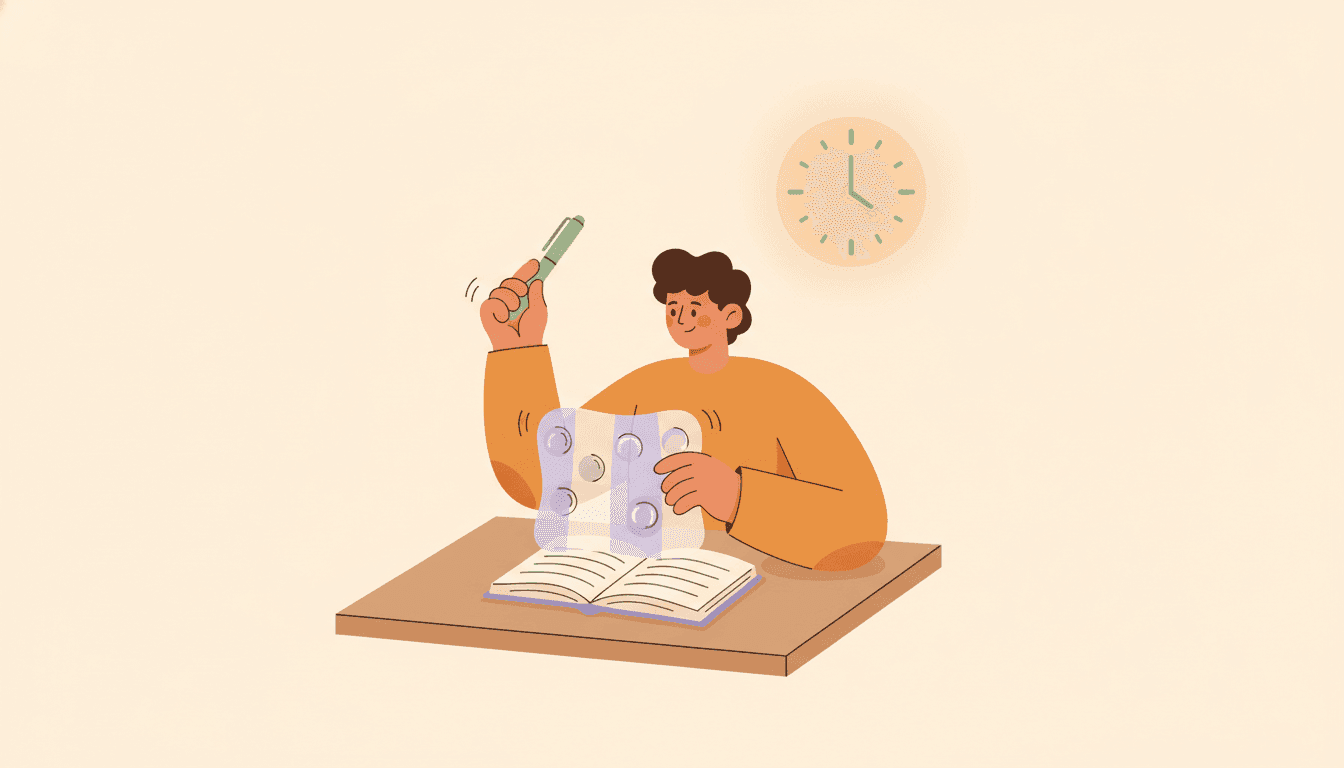
Bubble wrap is one of the cleanest fidgets ever invented. It is rhythmic, tactile, has a clear ceiling, makes a small satisfying release, and, crucially, it does not respond. Pop a few while you read the rest of the article. Your hands will be quieter and your eyes will keep up better.
Try this fidget
Bubble wrap that respects your time. Tap to pop.
Notice that you can do that with one hand while reading. That is the test of a good fidget — it runs in the background while your attention stays where you put it.
How to Fidget Without Losing Time
The goal is not to fidget less. It is to keep fidgets in their place: supporting attention, not consuming it.
Choose contained, low-stakes fidgets.
A fidget toy, a piece of putty, a textured stone, a pen click, bubble wrap, a hair tie. Anything with a physical ceiling. The defining feature is that the fidget has nothing to give back to you — it cannot start an autoplay, suggest a related video, or escalate. If a fidget can interrupt you, it is not really a fidget; it is a distraction in disguise.
Beware the screen-fidget trap.
The phone is the most expensive fidget in human history. It feels like the same gesture as a pen click, but it never returns you to the task. If you find your hand reaching for it during cognitively demanding moments, put a real fidget in your pocket and put the phone in another room. The hand will reach for whatever is nearest — make the nearest thing be something that cannot pull you in.
Pair fidgeting with an external time anchor.
Even a contained fidget can run longer than you intend. The simplest fix is a steady hourly cue from outside your head — a calm voice or a gentle chime that says the time, on the hour, every hour. This is the principle behind TimeAware: fidget all you want; the day stays in view, and you notice when the fidget has wandered into the foreground. Without an anchor, time spent fidgeting feels indistinguishable from time spent working, which is a small, everyday version of ADHD time blindness.
Match fidget intensity to task demand.
Boring tasks need bigger fidgets — a rhythmic foot-tap, a pen-spin, a stress ball. Truly engaging tasks need smaller ones, or the fidget itself becomes a distraction. Pay attention to which fidget you reach for; it is a real-time read on how much your brain is working.
Schedule fidget breaks instead of fighting the impulse.
If you are going to fidget anyway, give it a window. Two to five minutes between focus blocks, deliberately spent on something kinetic — pacing, stretching, popping bubble wrap, throwing a ball at a wall — gives your brain the same movement the involuntary fidget would have, and resets your attention for the next block. This is far more efficient than thirty minutes of distracted scrolling that you did not actually choose.
Keep a default fidget within reach.
Decide once what your go-to fidget is and put it where your hand naturally lands. The decision becomes automatic and your brain stops freelancing. Many ADHD adults who fidget effectively have a single trusted object — a worry stone, a favourite pen, a fidget cube — that lives within arm's reach of where they work.
Making Peace With the Fidget
Fidgeting is not a bug. It is one of the things your brain is doing right — a quiet biological workaround for an attention system that needs a little extra input. The trick is making sure your fidgets work for you instead of against you: keeping them small, automatic, and unhooked from the screen that wants your day.
If you have read this far, you have just done the thing — sat with text, possibly fidgeting, and stayed in the chair. The next step is making that the default rather than a happy accident. Pair a contained fidget with an external time anchor and most of the cost of the trait disappears.
If your fidgeting tends to escalate into hours of scrolling, our companion piece on hyperfocus explains why your brain keeps pulling you back in. And if it shows up as not being able to start at all, task paralysis covers the freeze on the other end of the same dopamine spectrum.
Frequently asked questions
Is fidgeting in ADHD a sign that medication isn't working?
Not on its own. Fidgeting is a baseline self-regulation behaviour and does not necessarily indicate that medication is too low or wearing off. Medication usually changes the type and intensity of fidgeting, not whether it happens at all. If you have noticed a sudden, large change — much more or much less — talk to your prescriber, but background fidgeting is normal and often desirable.
Does fidgeting actually help focus, or am I just rationalizing it?
Studies, mostly in children so far, have found that people with ADHD tend to perform better on demanding tasks when they move more, and a 2024 study of adults found more fidgeting on correct answers than on errors. Movement seems to help regulate alertness. The "just sit still" advice is not just unkind; it is neurologically counterproductive for ADHD brains.
What is the difference between ADHD fidgeting and a tic?
Fidgeting is voluntary or semi-voluntary movement that is regulated by attention; you can usually pause it if you actively choose to. A tic is involuntary, often preceded by an urge, and feels closer to a sneeze than a habit. The two can coexist, especially in people with both ADHD and Tourette syndrome, but they are distinct phenomena and respond to different interventions.
Are fidget toys evidence-based or just a fad?
The evidence for natural fidgeting is stronger than the evidence for any particular toy. A 2025 study that gave some adults with ADHD a fidget ball during a stressful task found no clear difference in heart-rate measures compared with those who had none. Fidget toys are not a magic bullet, but for many people they are a low-cost, low-risk experiment in making fidgeting useful instead of disruptive.
How do I fidget at work without being disruptive?
Pick silent, low-visibility fidgets — putty, a stress ball, a fidget cube under the desk, leg bouncing rather than pen clicking. If you are in a video meeting, off-camera leg or hand movement is invisible. The goal is to find something your colleagues do not notice but your brain does.
My fidgeting always becomes hours of scrolling. Is that still fidgeting?
It starts as fidgeting and becomes something else. Once an activity captures your attention rather than supporting it, it has crossed into distraction or hyperfocus territory. The interventions are different — for true fidgets, contain them; for the spiral, you need an external interrupt like a steady hourly cue or a deliberate stopping rule.
Should I try to fidget less?
Almost never. The more useful question is which fidgets, when, and at what cost. Replacing a phone-scroll with a worry stone is a huge net improvement; replacing a worry stone with grim self-control is a net loss. Aim for cleaner fidgets, not fewer.
This article is for education, not medical advice. For diagnosis or treatment, talk to a qualified clinician. How we research our articles