ADHD Emotional Dysregulation: Why Feelings Arrive at Full Volume
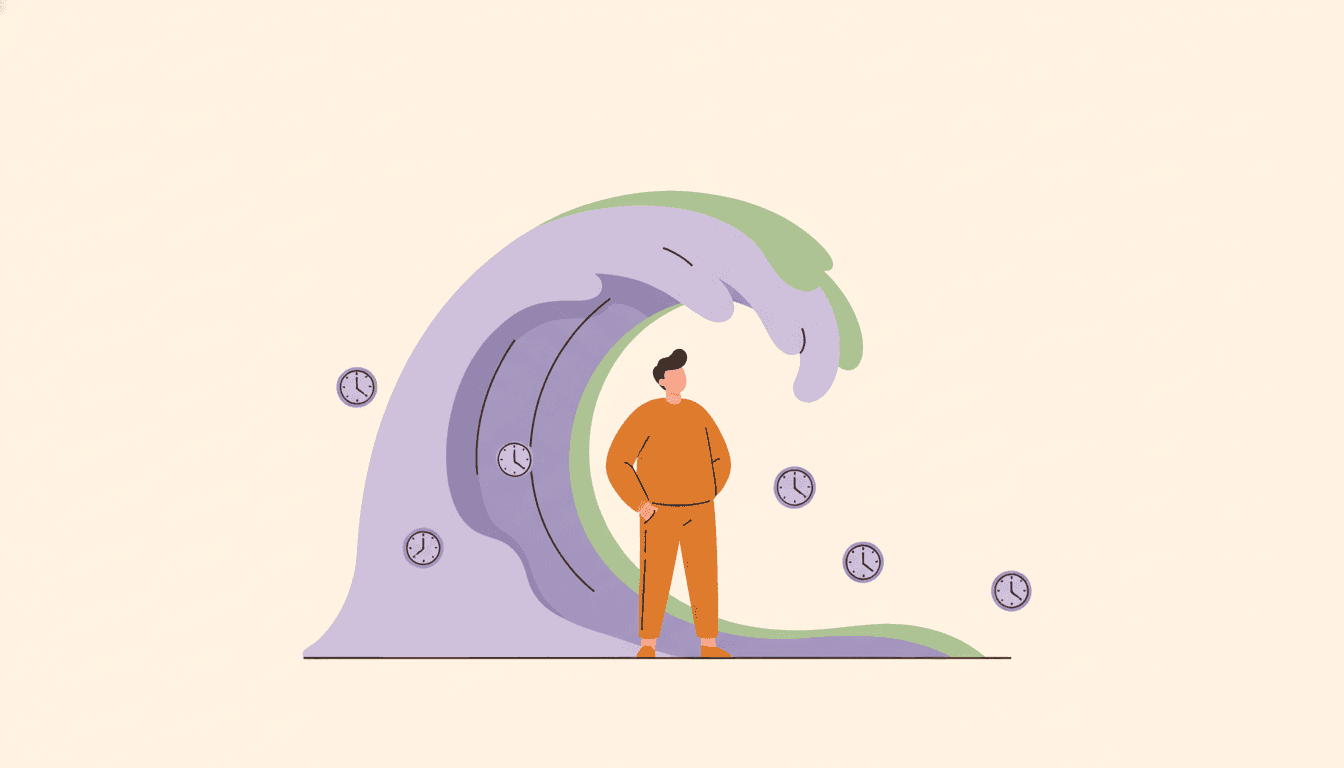
Someone sends a two-word reply to a message you spent ten minutes writing. Before you have consciously read it, something has already happened in your chest. Not a thought — a physical event, arriving whole, at full volume, with no ramp.
Twenty minutes later you can explain perfectly reasonably why the two-word reply was almost certainly about their day and not about you. You know this. Knowing it does not turn the feeling off. That gap — between what you understand and what your nervous system is doing — is one of the most exhausting and least discussed parts of having ADHD as an adult.
What Is Emotional Dysregulation in ADHD?
Emotional dysregulation is difficulty modulating the intensity and duration of an emotional response, rather than difficulty having appropriate emotions. The feeling itself is usually a reasonable reaction to the situation; what differs is that it arrives faster, hits harder, and persists longer than the situation warrants, and that it is very hard to steer once it has started.
It is worth being precise about its status. Emotional dysregulation is not one of the diagnostic criteria for ADHD in the DSM-5, the manual used in the United States. It is, however, treated as one of the fundamental features of the condition in European diagnostic frameworks, and clinicians who specialise in adult ADHD frequently describe it as among the most impairing parts of the condition — and among the most consistently missed.
The Neuroscience: A Regulation Problem, Not a Feeling Problem
The useful distinction here comes from Russell Barkley, who has argued for years that ADHD is a disorder of self-regulation rather than attention. Under that model, the same executive systems that let you hold a goal in mind, delay a response, and inhibit a first impulse are also what let you sit between a feeling and your reaction to it. They are not separate machinery. They are the same machinery, applied to a different input.
So if inhibition is the core difference in ADHD, you would predict that emotions arrive un-inhibited. That is precisely what people report. The feeling is not larger at source — it simply reaches you without passing through the filter that would normally soften and delay it.
This also explains the duration problem. Shifting attention away from a feeling requires the same executive flexibility that makes switching between tasks difficult. Once the emotion has your attention, redirecting it is a transition — and transitions are expensive. The feeling does not linger because you are dwelling on it. It lingers because leaving it is a manoeuvre your brain finds costly.
The related experience many people describe is rejection sensitivity — an overwhelming response to perceived criticism or rejection, which the psychiatrist William Dodson named rejection sensitive dysphoria in the 1990s. It is a description rather than a formal diagnosis, and we have written about what it is and is not separately.
Common Signs You Might Recognize
- Nought to full intensity with nothing in between. Other people seem to have a dimmer switch. You appear to have a light switch.
- Insight does not help in the moment. You can narrate exactly what is happening and why it is disproportionate, and it changes nothing.
- The recovery is longer than the trigger. A ninety-second interaction can cost the rest of the afternoon.
- Positive emotions are dysregulated too. Excitement arrives at the same volume — which is why enthusiasm can tip into overcommitment before you have thought it through.
- You are conflict-averse out of proportion to the conflict. Not because disagreement is frightening, but because you know what the next four hours will cost.
- Physical before cognitive. You notice your chest, your jaw or your stomach before you have identified the emotion.
- Enormous effort goes into not showing it. Masking the response is its own drain, and a common route into ADHD burnout.
Why "Just Calm Down" Advice Misses
Most emotional-regulation advice is written for a nervous system that offers a gap between stimulus and response — advice like noticing the feeling arising, pausing before reacting, or choosing a different interpretation. All of it assumes there is a moment in which to choose.
For a lot of people with ADHD, that moment does not reliably exist. The response is already underway by the time it becomes available to consciousness. Technique aimed at the gap cannot help when the gap is the missing part.
What tends to work instead operates either much earlier — on the conditions that make dysregulation more likely — or much later, on shortening the recovery. Very little works in the two seconds after the message arrives, and it is worth knowing that so you stop judging yourself for failing at something structurally unavailable.
What Actually Helps
Name the mechanism, not the feeling.
"I am having a dysregulation response" does something that "I am upset" does not: it identifies the experience as a known process with a known duration. That prediction matters enormously, because the worst part of a big feeling is often the fear that it will not end. Knowing it typically passes in twenty or forty minutes converts an emergency into weather.
Protect the physical baseline first.
This is unglamorous and it outperforms almost everything else. Emotional regulation degrades sharply with poor sleep, missed meals, and dehydration — and it degrades much faster in ADHD than most people expect. A very large proportion of what feels like a character problem at nine in the evening is a blood-sugar and sleep problem wearing a disguise. If your reactions have been worse lately, audit sleep before you audit yourself.
Buy the delay externally, since you cannot generate it internally.
You cannot manufacture the missing pause, but you can install one outside yourself. A rule that you do not reply to anything emotionally significant for one hour is a functional substitute for impulse control — it does the same job, from the outside. Drafting the reply and not sending it works well, because it discharges the urgency without the consequences. An hourly audio cue helps here more than it sounds like it should: it gives you a fixed marker to wait for rather than an unbounded stretch of trying to feel differently, which is what TimeAware is built to provide.
Move, if you can manage it.
Physical movement shortens the recovery for most people, and it does not need to be exercise in any structured sense. Walking to the end of the road counts. This is not about mood improvement in the general sense — it appears to help specifically with discharging the physiological component, which is the part still running long after the thought has been resolved.
Decide in advance what you do, so you are not deciding during.
Executive function is at its least available exactly when you need it here, so any plan requiring in-the-moment judgement will fail. Pick one protocol now and use it every time: leave the room, put the phone face down, walk for ten minutes, revisit at the next hour. A single automatic sequence beats a good decision you cannot make.
Tell the people close to you what is happening.
Not as an apology and not as an excuse — as information. "When I go quiet after something like that, I am not sulking, I am waiting for it to pass, and it usually takes about half an hour" prevents an enormous amount of secondary damage. Most relational harm from dysregulation comes from other people's interpretation of the withdrawal rather than the withdrawal itself.
Take it to a clinician if it is running your life.
This is the one worth saying plainly. Severe emotional dysregulation overlaps with several other conditions, some of which have specific and effective treatments, and it is not something to sort out from a blog post. If your reactions are damaging your relationships or your work, or if you are frightened by their intensity, that is a conversation for a doctor or therapist who knows adult ADHD — not a personal-discipline project.
A Kinder Frame
The cruellest thing about this particular difficulty is that it is invisible as a mechanism and extremely visible as behaviour. Nobody sees the absent buffer. They see the reaction, and they draw conclusions about your maturity from it — and because you cannot see the buffer either, you have probably drawn the same conclusions about yourself for a very long time.
The feeling was never the problem. What is missing is the half-second of distance that would have let you meet it — and distance can be built outside you when it cannot be found inside.
You are not too sensitive, too dramatic, or too much. You are running an emotional system without a component most people have, and doing it while trying to appear as though nothing is happening. That is not a flaw of character. It is a workload — and it is one that gets lighter when the scaffolding stops having to be made of willpower.
Frequently asked questions
Is emotional dysregulation an official symptom of ADHD?
Not in the DSM-5, the diagnostic manual used in the United States, where the ADHD criteria cover inattention, hyperactivity and impulsivity. European diagnostic frameworks treat emotional dysregulation as one of the fundamental features of the condition, and many clinicians who specialise in adult ADHD consider it one of the most impairing aspects. The mismatch is a large part of why it so often goes unaddressed.
Why can I understand my reaction is disproportionate and still not stop it?
Because comprehension and regulation run on different systems. Understanding happens after the response is already underway — the emotional reaction reaches you before the executive processes that would normally moderate it have engaged. Insight arriving late is the expected pattern here, not a sign you are not trying hard enough.
Is this the same thing as being bipolar?
No, though they are sometimes confused and adults with ADHD are occasionally misdiagnosed. ADHD emotional dysregulation involves rapid shifts that are triggered by events and typically resolve within minutes to hours. Bipolar mood episodes last days to weeks and are not usually tied to a specific trigger. Because the distinction genuinely matters for treatment, it is worth a proper assessment rather than self-diagnosis.
Does emotional dysregulation get better with age?
Many adults report it becomes more manageable, usually because they have built better external structures and learned their own patterns, rather than because the underlying reactivity has changed much. Life circumstances matter a great deal too — sleep, stress load and the amount of masking required all move it substantially in either direction.
Do stimulant medications help with emotional dysregulation?
Some people find their emotional reactivity improves alongside other symptoms, and some find it unchanged or affected differently at different points in the day. Responses vary widely, and this is genuinely a question for your prescriber rather than something to work out from general advice, since it can influence which treatment is appropriate.
How do I explain this to a partner?
Describing the mechanism and the timeline usually works better than apologising: that the reaction arrives before you can moderate it, that going quiet is recovery rather than punishment, and roughly how long it takes to pass. Most of the relational damage comes from how the withdrawal gets interpreted, so giving people an accurate interpretation in advance prevents a lot of it.
When should I seek professional help for this?
If it is damaging your relationships or your work, if the intensity frightens you, or if you find yourself organising your life around avoiding any possibility of conflict, it is worth talking to a clinician who understands adult ADHD. Severe emotional dysregulation overlaps with several other conditions that have specific treatments, and that is not something to sort out alone.