ADHD Mornings: Why Leaving the House Takes So Much Longer Than It Should
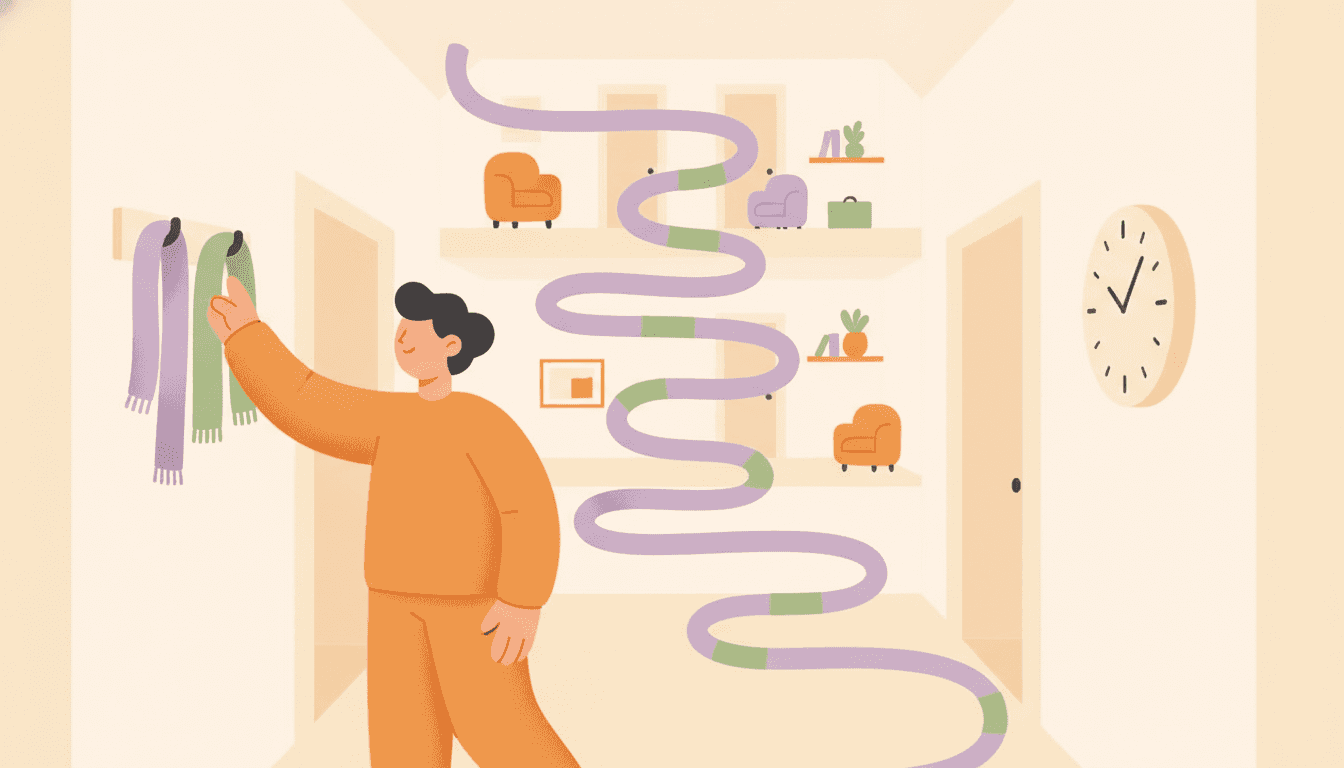
You set the alarm for seven with the best intentions. It is now eight thirty-five, you needed to leave at half past, and you are standing in the hallway holding one shoe with the distinct sense that you have been busy the entire time without being able to name what you did.
Somewhere in there you reorganised part of a drawer. You definitely made coffee, though you are not sure where it is. The ninety minutes are gone, and the frustrating part is that they did not feel wasted while they were happening.
Why Is the Morning Routine So Hard With ADHD?
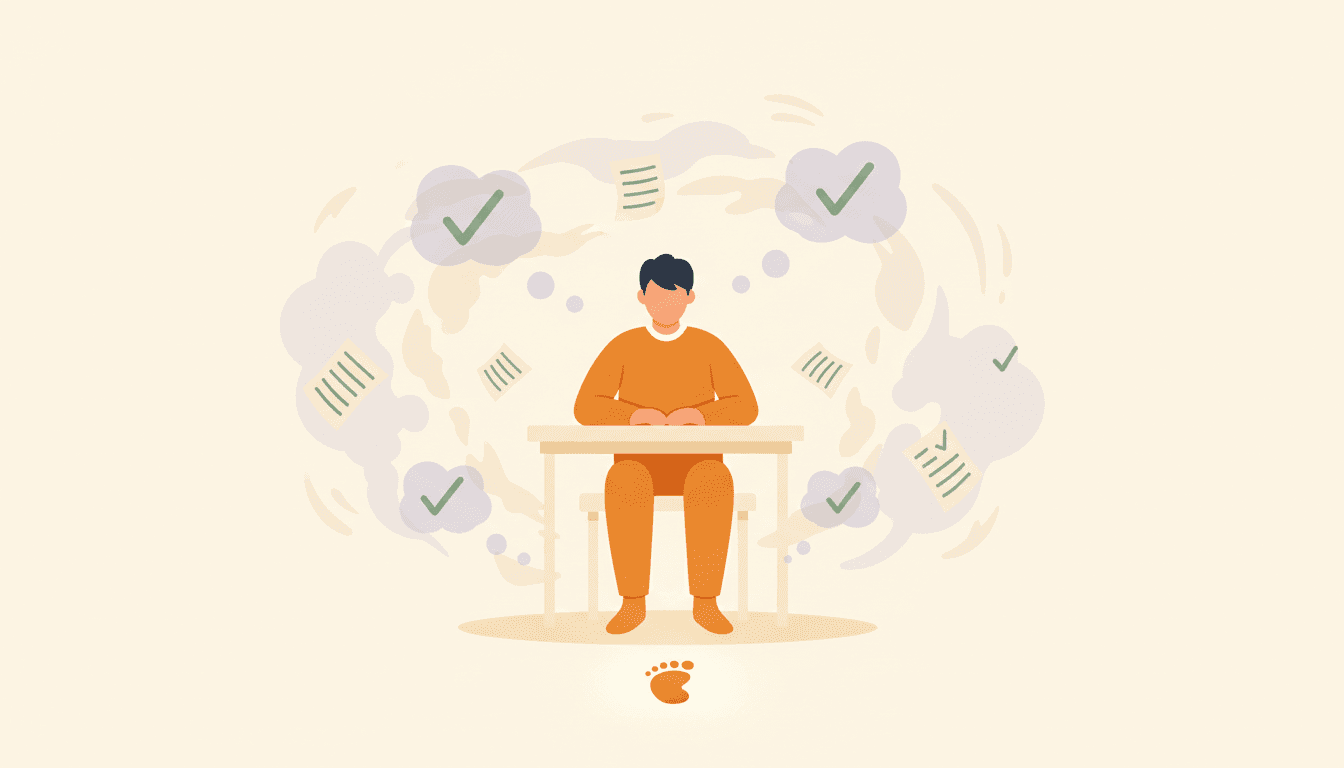
The morning is not a single task but a long sequence of small dependent ones, each requiring a decision, and the sequence has no external structure to hold it together. Nothing tells you when to move from one step to the next. Every handover is a transition, every transition costs executive function, and the whole chain runs at the point in the day when that resource is least reliably available.
This is why mornings resist willpower so stubbornly. You are not failing at one hard thing. You are running forty small ones with no scaffolding, and the failure of any single link stalls everything downstream.
The Neuroscience: A Sequencing Problem
Russell Barkley's account of ADHD as an executive-function difference is useful here because the morning demands almost every capacity on the list at once — holding a sequence in working memory, inhibiting distraction, initiating each step, and tracking elapsed time throughout.
The sequencing part deserves particular attention. To get out of the door you have to keep an ordered plan alive while executing it, updating your position as you go. That is a working-memory task, and working memory is exactly what is in short supply. So the plan degrades. You know you are going somewhere, but the ordered list of what remains has quietly become a vague sense of things left to do — and a vague sense cannot tell you that you have twelve minutes and three steps.
Then there is the invisible-step problem. When you picture your morning you picture the significant events: shower, dressed, breakfast, out. What does not make it into the mental model is finding the other shoe, deciding about the coat, the trip back upstairs for the thing you forgot, and the two minutes at the door wondering about the hob. These are where the time actually goes, and they are absent from every plan you have ever made. This is the same mechanism behind chronic lateness, at much finer resolution.
The final factor is that mornings are dense with decisions at the moment decision-making is weakest. What to wear, what to eat, whether there is time for the thing. Each is small; together they are a substantial executive load before the day has started.
It is also worth noticing that mornings offer almost no feedback. In most of the day something external tells you how you are doing — a colleague waiting, a meeting starting, a queue moving. Alone in your own hallway there is nothing at all, so the only instrument available is your own sense of elapsed time, which is precisely the instrument ADHD makes unreliable. You are flying the hardest part of the day on the one gauge you cannot trust.
Where the Time Actually Goes
- Searching. Keys, the other shoe, the charger, the card. Almost always the largest single category, it scales directly with how much lives out of sight, and it is where a good deal of the ADHD tax gets paid.
- The gap between waking and moving. Awake at seven, vertical at seven twenty-five, with no memory of the intervening time.
- One task that expands. You have twenty minutes so you start something small, and it is the reason you are late.
- Wardrobe decisions. Not vanity — decision load, at the worst possible hour.
- The return trips. Upstairs for the thing, back down, upstairs again for the other thing.
- Doorway checking. Hob, door, window, iron. Genuine uncertainty because you were not attending when you did it.
- The phone. Picked up to check one thing at seven fifty. Put down at eight ten.
Why Waking Up Earlier Does Not Fix It
It is the first solution everyone tries and it fails in a specific and predictable way: the morning expands to fill whatever time you give it. An extra half hour does not get banked as a buffer, because there is nothing enforcing the pace — no external structure marking where you should be by now. The additional time gets absorbed by the same searching and drifting, and you leave at the same moment feeling worse, having also lost half an hour of sleep.
Since less sleep degrades executive function, waking earlier can genuinely make the morning harder rather than easier. The problem is not the quantity of time available. It is that nothing inside the ninety minutes tells you where you are supposed to be.
What Actually Helps
Move everything you can into the night before.
This is the highest-leverage change by a wide margin, and it works because evening-you has executive function that morning-you does not. Clothes out, bag packed, keys in the bowl, lunch made, tomorrow's one decision already made. Every step relocated to the previous evening is a step removed from the sequence entirely, and shortening the sequence beats speeding it up.
Fix the searching problem with fixed homes.
Searching is usually the biggest single cost, and it is largely solvable: one bowl by the door for keys and card, one hook for the bag, one place for shoes. Things left out of sight tend to stop existing, so keep the critical few visible and consistent rather than tidy. It looks cluttered and it saves ten minutes a day.
Mark the hour out loud instead of checking the clock.
Checking the time requires remembering to check, which is precisely the thing that fails when you are mid-sequence. An ambient signal works differently — it reaches you without being requested, so eight o'clock becomes something you hear rather than something you were meant to notice. This is what TimeAware is built for: a gentle cue on the hour, so the morning has an external pace instead of running entirely on your own unreliable sense of elapsed time.
Use fixed checkpoints rather than a full schedule.
Minute-by-minute plans are too brittle to survive contact with an actual morning. Two or three checkpoints work far better: dressed by eight, out of the kitchen by eight fifteen, shoes on by eight twenty-five. Each tells you whether you are ahead or behind while there is still time to act, which a departure-time alarm cannot do.
Delete decisions rather than making them faster.
Wear the same thing. Eat the same breakfast. Take the same route. This sounds joyless and it is genuinely liberating, because every removed decision is executive function returned to the sequence. Save novelty for the hours when you can afford it.
Put the phone somewhere else entirely.
Not face down — in a different room, charging. The morning phone check is the single most reliable way to lose twenty minutes, and no amount of intention has ever reliably prevented it. This is not a discipline problem to be solved by trying harder; it is a proximity problem, and proximity is easy to change.
Build a fixed launch sequence and never vary it.
Keys, wallet, phone, bag, door — the same five items in the same order every day. A sequence that never changes eventually stops consuming working memory and runs automatically, which also removes the doorway uncertainty, because you no longer have to remember whether you did it. You did, because you always do.
A Kinder Frame
Mornings carry an unreasonable amount of moral weight. Getting up and leaving the house is treated as the baseline competence from which everything else follows, so struggling with it feels like failing the entry requirement for adult life — before the day has even started. That framing does real damage, and it is applied most harshly by the person it is about.
But nothing about the morning is actually simple. It is the longest unstructured sequence of dependent tasks most people attempt in a day, run without supervision, without external pacing, and at the hour when the relevant machinery is least available. That it goes wrong is not surprising. It would be more surprising if it went smoothly.
You are not failing at something easy. You are running the hardest sequence of your day at the hour you have least to run it with.
The fix is not more discipline and it is certainly not an earlier alarm. It is a shorter sequence, fewer decisions, visible objects, and something outside your own head keeping the pace. Move half of it to the night before and let the hour announce itself, and the ninety minutes stop disappearing.
Frequently asked questions
Why does my ADHD morning routine take so much longer than I plan for?
Because the plan contains about eight steps and the morning contains about forty. When you mentally simulate the sequence you picture the significant events — shower, dressed, breakfast — and the connecting steps drop out: finding things, return trips upstairs, decisions at the wardrobe, checking the hob. Those invisible steps are where most of the time goes, and they never appear in the estimate.
Will waking up earlier help?
Usually not, and it can make things worse. The morning expands to fill the available time because nothing inside it enforces a pace, so the extra half hour gets absorbed rather than banked. Since reduced sleep also degrades executive function, you often end up leaving at the same moment with less capacity. Adding structure works better than adding time.
Why do I lose so much time searching for things?
Because objects that are out of sight tend to stop being mentally available, so retrieval becomes a genuine search rather than a recollection. Searching is typically the single largest time cost in an ADHD morning. Giving a small number of critical items fixed, visible homes — one bowl, one hook, one shelf — usually saves more time than any other physical change.
Why can I not just get out of bed when the alarm goes off?
Waking is itself a transition, and transitions require inhibiting the current state, loading the next one, and initiating movement — all executive operations, attempted at the point in the day when that capacity is lowest. The gap between being awake and being vertical is real and predictable, and it is worth budgeting for rather than treating as a nightly failure of will.
How do I stop losing twenty minutes to my phone?
Change its location rather than your intentions. Charging it in another room overnight works far more reliably than putting it face down or relying on resolve, because it converts a discipline problem into a proximity problem. Proximity is easy to change; morning willpower is not.
Should I write out a full morning schedule?
Detailed minute-by-minute schedules tend to be too brittle — one delay invalidates the whole thing and it gets abandoned. Two or three checkpoints work much better: dressed by a certain time, out of the kitchen by another. Checkpoints tell you whether you are ahead or behind while there is still time to do something about it, which a single departure alarm cannot.
Does preparing the night before really make a difference?
It is the single most effective change most people make, because it uses evening executive function to reduce the number of morning steps. Every task moved to the night before is removed from the sequence entirely rather than merely done faster — and shortening the sequence is what actually helps, since the difficulty scales with the number of transitions rather than the total work.